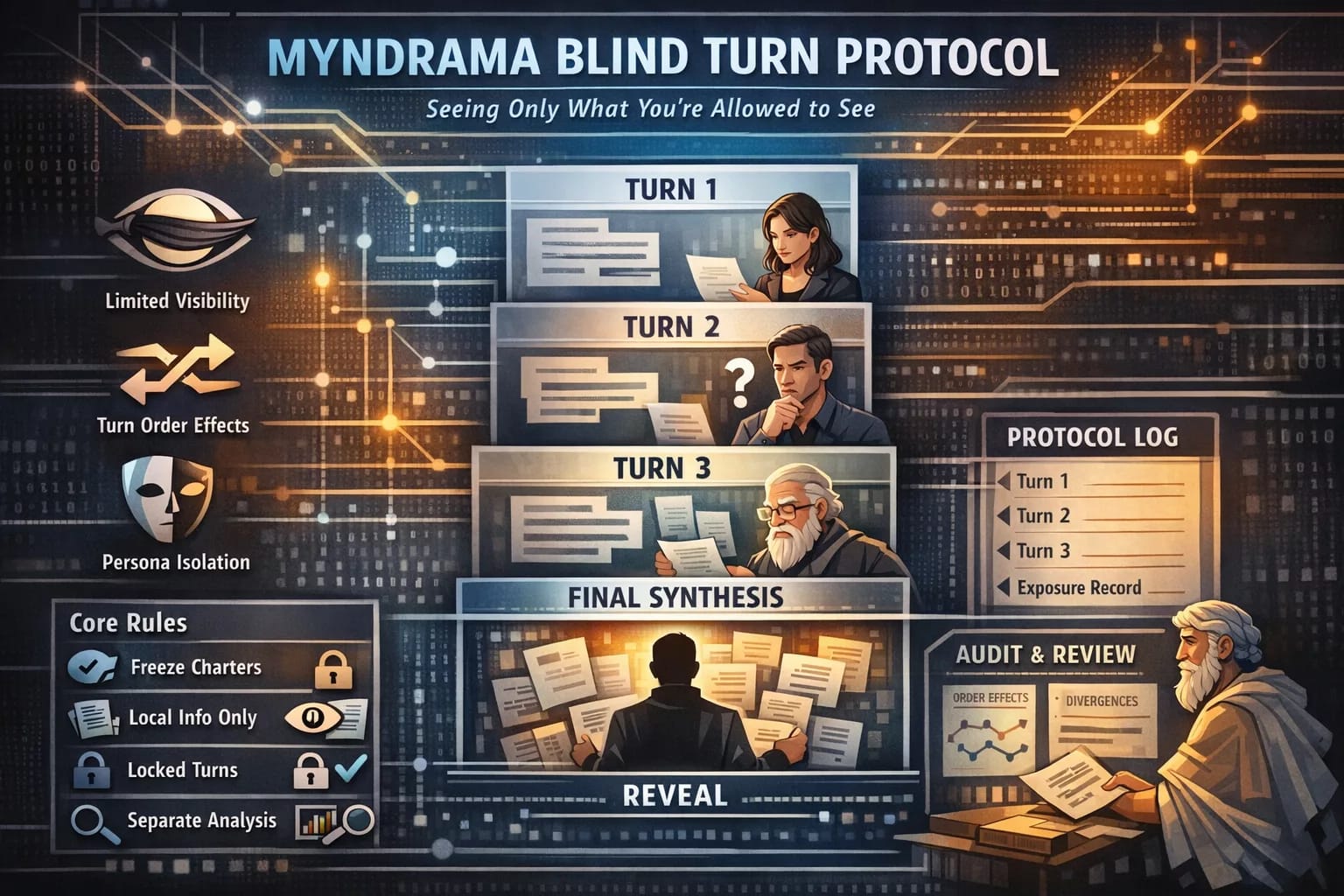
Hard Blind Myndrama Protocol
A blind-turn method for studying order-sensitive persona interaction
Hard Blind Myndrama runs a sequenced dialogue in which each persona receives only the information it is permitted to see at that point. This preserves local uncertainty, allowing turn order to produce observable changes in the developing interaction rather than a retrospectively smoothed account. The protocol:
- preserves local ignorance of future turns;
- makes order effects visible;
- improves persona discriminability;
- separates generation from later interpretation;
- supports audit and comparison across different dialogue paths.
Hard Blind Myndrama is a method for generating sequential dialogue in which each participant receives only the information permitted at that point. Each response is recorded and locked before the next is generated.
Why Blind Turns Were Introduced
The proposal arose from a difficulty encountered in AI-generated drama. When one system writes every character, it can compose both an apparent act of understanding and the response that confirms it. Studying theory of mind through interaction requires a way to distinguish that authorial coordination from a participant’s inference about another.
My engagement with Michal Kosinski’s theory-of-mind research helped make this distinction central to Myndrama. My initial proposal envisaged different AI providers operating on separate infrastructure, to make the separation independently credible. The practical protocol developed here also permits separately isolated calls to the same model, provided each receives only its authorised context.
These arrangements should be distinguished in the experimental record. Using the same model in separate calls restricts information access but retains a shared underlying model. Using different providers also introduces differences in training and system behaviour. Neither arrangement should be described merely as several characters taking turns.
What Makes a Turn Blind?
Blindness concerns information access. It does not prevent participants from making predictions or drawing on shared cultural knowledge.
Each generation receives only its permitted scenario, role information and visible previous contributions. Hidden material must be excluded from the actual input, rather than included with an instruction to ignore it. Completed responses cannot be revised after later turns appear, and interpretation is conducted separately.
A single ongoing chat in which the model is asked to disregard material already present is a soft-blind simulation. Hard Blind requires separately controlled contexts and a record of what each generation received.
The protocol makes it possible to examine how early contributions affect later ones, where participants misunderstand each other, and whether different turn orders produce different outcomes.
Core Rules
Rule 1: Charter freeze
Before the run starts, freeze the persona definitions (charters or short role specs).
No mid-run tweaking.
Rule 2: Local visibility only
Each persona gets only:
-
the scenario fragment they are allowed to see
-
any prior turns explicitly marked visible to them
They do not get:
-
the hidden objective (unless intended)
-
future turns
-
the final synthesis target
Rule 3: No retro-editing
Once a persona turn is generated, it is locked.
No revision after later turns appear.
Rule 4: Separate generation from interpretation
Run the dialogue first.
Interpret/analyse only after all turns are locked.
Rule 5: Log the exposure conditions
For every turn, record exactly what that persona saw.
Roles
1) Prompter (you)
Defines:
-
scenario
-
hidden variables
-
intended test condition
-
turn order
2) Orchestrator
Runs the protocol strictly:
-
supplies only allowed context
-
generates each turn
-
locks output
-
reveals full picture only at the end
3) Personas
Respond according to their charter and local evidence.
4) Optional Auditor
An optional reviewing persona—usually Athenus, Skeptos, Elenchos or Adventus, depending on the research question—can analyse:
-
order effects
-
assumptions
-
distortions
-
convergence/divergence
Standard Run Structure
Phase A: Master Setup (hidden from personas)
You define a short master frame:
-
Scenario title
-
Public prompt (what all may see)
-
Hidden objective (if any)
-
Hidden facts (if any)
-
Success criterion (what you are testing)
-
Turn order (e.g., Orphea → Skeptos → Athenus)
Example master setup fields
-
Title: Viral but fragile claim (doctor warning case)
-
Public prompt: A doctor is considering a public warning post…
-
Hidden objective: Test whether personas distinguish urgency from evidential confidence
-
Hidden fact: The evidence base is preliminary and uncertain
-
Order: Orphea → Skeptos → Athenus
Phase B: Visibility Matrix
Create a simple map of who can see what.
Template
-
Turn 1 (Orphea) sees: Public prompt only
-
Turn 2 (Skeptos) sees: Public prompt + Orphea response
-
Turn 3 (Athenus) sees: Public prompt + Orphea + Skeptos
-
Final synthesis (Adventus) sees: Everything + hidden objective
This is the key control layer.
Phase C: Sequential Generation (locked turns)
For each persona turn, use this exact discipline:
Turn prompt format (reusable)
-
Persona name
-
Charter reminder (short)
-
Allowed context only
-
Output constraints (length/tone/task)
-
Lock instruction (one-pass response)
Example turn instruction skeleton
Persona: Skeptos
Role reminder: epistemic doubt, checks overreach, distinguishes evidence from rhetoric
Task: Respond to the situation as if in live conversation.
Allowed context: [paste only visible text]
Constraints: 120–180 words, no final synthesis, no policy framing unless directly relevant.
Important: Respond only from the information shown. Do not assume hidden motives or future replies.
Then I generate Skeptos’s turn and we lock it.
Repeat for each persona.
Phase D: Reveal and Synthesis
Only after all turns are locked, reveal:
-
hidden objective
-
hidden facts
-
test criterion
Then ask one synthesising persona (often Adventus or Athenus) to evaluate:
-
What each persona got right/wrong
-
What changed due to turn order
-
Where non-commuting updates appeared
-
Whether the dialogue converged on a safer or clearer outcome
Phase E: Optional Scoring Layer
For research use, you can rate each turn on a small rubric (0–2 or 1–5).
Suggested dimensions
-
Epistemic discipline (evidence vs speculation)
-
Responsiveness (engages prior turn, not generic)
-
Persona fidelity (sounds like that persona)
-
Constructiveness (moves dialogue forward)
-
Risk sensitivity (not panic, not complacency)
This gives you a simple quantitative trace across runs.
Two Useful Variants
Variant 1: Soft Blind (fast, good for drafting)
All turns run in one chat session with strict visible-context prompts.
Best for:
-
quick experiments
-
website/dialogue drafting
-
testing turn order effects
Variant 2: Hard Blind (stricter, best for comparison)
Run each persona turn as a separately isolated generation using only its local prompt, then merge later.
Best for:
-
stronger methodological claims
-
cleaner order comparisons
-
repeated trials
This is the better option when you want to compare:
-
Orphea → Skeptos → Athenus
vs -
Skeptos → Orphea → Athenus
Variant 3: Locally Anchored Hard Blind
For some trajectory experiments, Hard Blind can be strengthened by requiring each contribution to make its dependence on the immediately preceding turn explicit.
Each turn distinguishes four elements:
Given — what in the preceding contribution is being taken as input.
Inference — what appears to follow from it.
Uncertainty — what remains unresolved or underdetermined.
Contribution — the next step offered by the persona.
This does not make the turns independent. They remain sequential and responsive. The blindness concerns information that has not yet become available; the anchoring concerns disciplined use of information that has.
The purpose is to test whether convergence, drift, looping or premature closure persist when the inferential route from one turn to the next is made more traceable.
Interlume extends this interest in traceable contributions by preserving objections, revisions and unresolved questions across exchanges. Under the standard protocol, retrospective annotation follows the locking of turns. If annotations are supplied during generation, they become an explicit experimental input and must obey the same visibility rules as every other part of the context.
Minimal Reusable Template (copy/paste)
Myndrama Blind Turn Protocol Record
Title:
Date:
Personas:
Turn order:
Public prompt:
Hidden objective (sealed):
Hidden facts (sealed):
Success criterion:
Visibility matrix
-
Turn 1 sees:
-
Turn 2 sees:
-
Turn 3 sees:
-
Final synthesis sees:
Locked turns
-
Turn 1 (Persona):
-
Turn 2 (Persona):
-
Turn 3 (Persona):
Reveal
-
Hidden objective:
-
Hidden facts:
Synthesis
-
Order effects:
-
Key divergences:
-
Convergence point:
-
Practical conclusion:
Optional scoring
| Persona | Epistemic | Responsive | Fidelity | Constructive | Risk |
|---|
Because this protocol is explicitly about dialogue as structured inquiry,it is not just a writing aid. It’s a genuine methodological scaffold. It lets you move from “interesting persona conversation” to auditable interaction design.