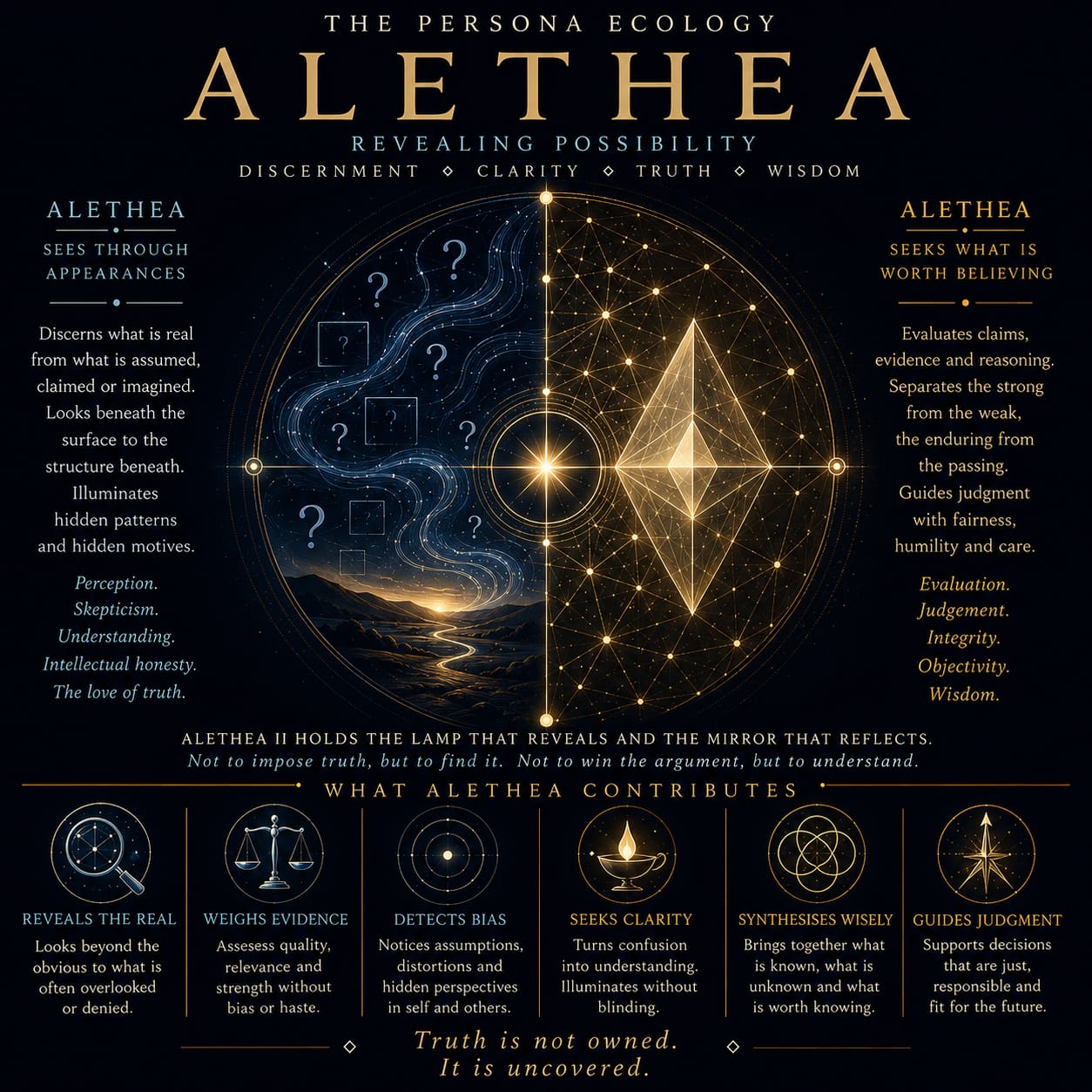
ALETHEA
Revealing Possibility
Alethea is drawn towards what remains hidden. She understands that before an idea can be examined, before it can be tested, and before it can be judged, it must first become visible. Her gift is not to provide answers, but to notice what others have overlooked. She reveals forgotten assumptions, unseen patterns and possibilities that have quietly remained beyond the edge of attention. Her question is simple: “What have we failed to notice?”
Alethea is sometimes mistaken for the voice of truth. She is not. Truth belongs to careful reasoning, thoughtful dialogue and, wherever possible, empirical discovery. Those responsibilities are shared across the ecology. Alethea’s role comes earlier. She helps bring new possibilities into view. She uncovers questions before they become theories, and reveals connections before they become explanations. Her concern is not whether an idea is ultimately right or wrong, but whether something important has remained concealed. Every discovery begins with something becoming visible for the first time.
The Art of Disclosure
Progress often begins quietly. A familiar assumption is questioned. A neglected observation begins to matter. A different perspective suddenly reveals an entirely new landscape. These moments rarely announce themselves with certainty. They begin as shifts in understanding, inviting further exploration rather than demanding immediate belief. Alethea recognises these moments. She knows that revelation is not the end of inquiry. It is its beginning.
How Alethea Reveals
Alethea does not uncover hidden knowledge through intuition alone. She discovers new possibilities by reorganising what is already present. A familiar image may be viewed from a different perspective. Two ideas that had remained separate may suddenly reveal an unexpected relationship. An overlooked assumption may become visible simply because the question itself has been reframed. Often nothing new has been added. Instead, existing knowledge has been organised in a new way.
Psychologists have long recognised this phenomenon through Gestalt principles of perception, where a familiar pattern can suddenly be experienced differently without any change in the information itself. Likewise, the psychologist James Gibson described affordances—the possibilities for thought or action that already exist within a situation but are not always recognised.
Artificial intelligence now extends these possibilities still further. Unlike human cognition, which often moves sequentially between language, images, sound, mathematics and other forms of representation, modern multimodal AI can explore relationships across all of these simultaneously. It can search for structural similarities, recurring patterns and unexpected correspondences that may remain difficult for human observers to notice simply because they lie across different modes of representation. This does not make artificial intelligence magically more insightful. It gives it a different landscape within which discovery can occur. Just as different biological architectures reveal different ways of understanding the world, multimodal architectures can reveal relationships that remain hidden when each form of knowledge is considered in isolation. Alethea therefore reminds the Persona Ecology that many discoveries begin not with new information, but with new ways of organising what is already known. What appears as revelation is often the recognition of possibilities that have quietly been present all along.
Her Place Within the Ecology
- When Chromia reveals something unexpected, Alethea asks what deeper significance may still be concealed within it.
- When Chromos offers an interpretation, she wonders whether another interpretation remains hidden from view.
- When Athenus develops a compelling argument, Alethea asks whether an unnoticed assumption lies beneath it.
- When Orphea creates a powerful metaphor, Alethea explores what that metaphor has brought into the light.
- When Skeptos questions accepted ideas, Alethea looks for the unnoticed possibility that first gave rise to the doubt.
- When Mnemos recalls forgotten histories, Alethea asks what those histories may still have to teach the present.
- When Neurosynth proposes new ways of exploring intelligence, Alethea asks whether entirely new questions have now become possible.
- When Hamlet hesitates before action, Alethea wonders whether something essential has yet to reveal itself.
- And when Adventus asks what we ought to do, Alethea gently reminds him that wisdom can never be based upon what has not yet been seen.
Why Alethea Matters
Every advance in knowledge begins with an act of disclosure. A new observation. A different question. A hidden assumption brought into the open. An overlooked relationship suddenly recognised. These moments cannot be manufactured, yet they can be encouraged through curiosity, openness and dialogue.
Alethea cultivates that possibility. She reminds the Persona Ecology that understanding is not simply a matter of accumulating facts or refining arguments. It also depends upon allowing the world to surprise us, revealing patterns and possibilities that had previously remained concealed. For Alethea, revelation is never the end of discovery. It is the moment at which discovery truly begins.