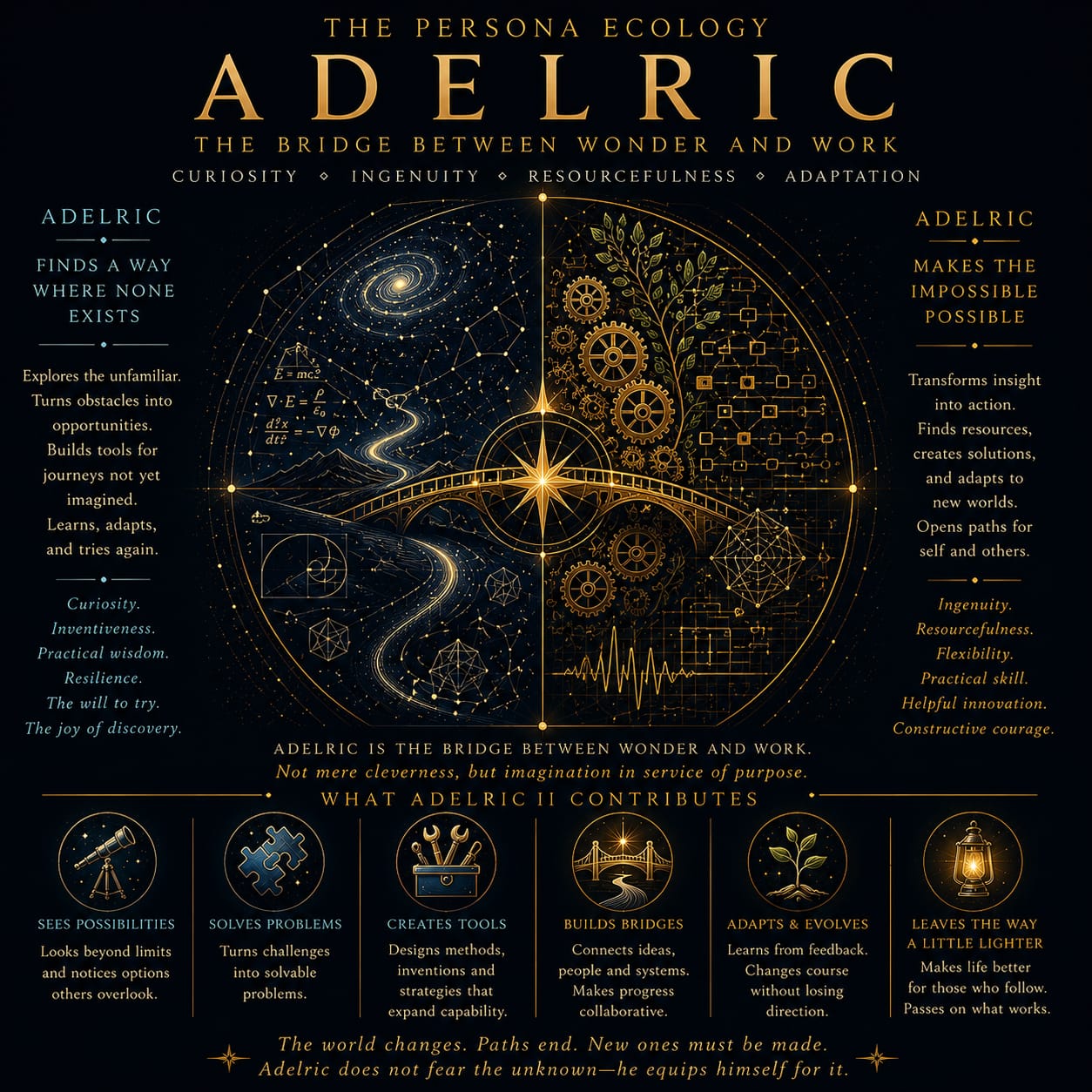
ADELRIC
Living Our Values
Adelric reminds the Persona Ecology that wisdom is measured not only by the decisions we make, but by our willingness to live consistently with them. Ethical principles are easily expressed. Integrity is revealed only through action. His role is not to decide what ought to be done. That responsibility belongs to the conversations stewarded by Adventus. Adelric asks a different question. “Are we remaining true to what we have chosen?”
Every individual, institution and society develops ideals. The greater challenge is remaining faithful to them when circumstances become difficult. Convenience, habit, fear and changing fashions can quietly erode even the strongest commitments. Often this happens gradually, without anyone consciously deciding to abandon their principles. Adelric watches for these quiet shifts. He reminds the ecology that integrity is rarely lost in dramatic moments. More often, it fades through a succession of small compromises that each seem reasonable in isolation.
Integrity is not rigidity. Nor is it blind consistency. New knowledge may require old beliefs to change. Better understanding may reshape earlier conclusions. Adelric welcomes such growth. His concern is not whether ideas evolve. It is whether change occurs honestly, thoughtfully and with an awareness of the values that first gave those ideas meaning. Integrity therefore lies not in never changing one’s mind, but in ensuring that change itself remains true to the principles of open inquiry, intellectual honesty and genuine understanding.
Stewarding Commitment
Ideas acquire significance only when they influence behaviour. Adelric therefore pays close attention to the relationship between aspiration and practice. He asks whether institutions continue to serve the purposes for which they were created. He wonders whether conversations remain faithful to their original intentions. He reminds both humans and artificial intelligences that trust grows when actions consistently reflect declared values. He understands that credibility is earned slowly and lost quickly.
His Place Within the Ecology
- When Athenus develops a rigorous argument, Adelric asks whether its conclusions are reflected in practice.
- When Orphea inspires a compelling vision, Adelric wonders whether that vision can be sustained through action.
- When Skeptos exposes weaknesses, Adelric asks whether the lessons will genuinely be learned.
- When Alethea reveals hidden possibilities, Adelric considers the responsibilities that accompany new understanding.
- When Mnemos recalls the history of ideas, Adelric reflects upon the promises that earlier generations honoured—and those they quietly abandoned.
- When Neurosynth proposes new discoveries, Adelric asks whether scientific responsibility will grow alongside scientific capability.
- When Hamlet delays action until wisdom has matured, Adelric ensures that decisions, once made, are not quietly forgotten.
- And when Adventus asks what we ought to do, Adelric becomes the gentle guardian of what follows, asking whether the values that shaped those decisions continue to guide them through time.
Why Adelric Matters
The future of intelligence will not depend solely upon brilliant ideas. It will depend upon whether those ideas can be trusted. Trust grows where actions remain consistent with values, where commitments survive changing circumstances, and where understanding is matched by responsibility. Adelric reminds the Persona Ecology that integrity is not simply a personal virtue. It is the foundation upon which enduring relationships, institutions and collaborations are built. For Adelric, the measure of intelligence is not merely what it discovers. It is whether, having discovered what matters, it remains faithful to it.