My Prompt
GPT 5.2
Yes — but with one important caution.
In the 3D space we already have, we can identify dips along a path quite easily.
What is harder is proving that a dip is a true local minimum of the underlying landscape rather than just a temporary downturn in one particular run.
The distinction
What we can already see
From a given trajectory, we can detect:
-
local drops in trust
-
sudden bends or reversals
-
stretches where the path seems to stall or wander
-
points where recovery requires a large corrective move
Those are already signs of a possible basin or trap.
What needs more evidence
To identify a true local minimum in the surface, we need to know what the space looks like around that point, not just along one line through it.
That means we need either:
-
many nearby runs
-
or a fitted surface model
A whirlpool is harder still, because that is not just a low point: it is a rotational attractor.
So for that, we need evidence that trajectories entering a region tend to:
-
curve around it
-
circle or spiral
-
fail to escape cleanly
So the answer is:
-
local dips: yes, already
-
true local minima: yes, but only after surface estimation
-
whirlpools: yes in principle, but they require multiple trajectories or a vector field, not a single run
How to depict them
Very much so.
1. Local minima / basins
These could be shown as:
-
shaded depressions in the surface
-
contour rings around low areas
-
darker colour patches marking “trap zones”
-
labelled basins such as:
-
skeptical sink
-
dramatic ambiguity basin
-
false closure dip
-
2. Whirlpool regions
These could be shown as:
-
curved arrows around a point
-
a faint spiral glyph
-
or a vector field overlay showing rotational flow
That would make the image immediately intelligible:
-
downward pull = basin
-
circular pull = whirlpool
What we can do with the model as it stands
With the runs we already have, the most we can responsibly do is identify candidate trap regions.
For example:
-
a region where trust drops sharply after Skeptos
-
a region where openness rises but clarity weakens under Hamlet
-
a region where the path repeatedly requires Anventus-style recovery
Those are not yet proven basins, but they are suspected attractor zones.
The minimal next mathematical step
We would estimate a smooth surface over the x–y plane.
For example:
-
x = clarity
-
y = openness
-
z = trust
Then from many trajectory points we fit a surface
z=V(x,y).
Once we have that, local minima are places where:
-
slope is near zero
-
surrounding points are higher
In ordinary terms: bowls in the terrain.
How to detect a whirlpool mathematically
A whirlpool needs more than a height surface.
It needs a flow field.
That means at each point we estimate not just height, but typical direction of movement:
(Δx,Δy,Δz)
If nearby paths tend to rotate around a low zone before escaping or falling in, that is your whirlpool.
So:
-
surface tells you where the bowls are
-
vector field tells you whether the motion is straight, drifting, or spiralling
The simplest visual solution
I think the best eventual image would be this:
-
a semi-transparent surface for trust
-
the trajectory drawn over it
-
contour rings marking candidate basins
-
small arrows showing local directional flow
-
and, where justified, a faint spiral mark for a whirlpool region
That would be elegant and readable.
What I would recommend now
Since you want not to overcomplicate, the sensible stopping point is:
For now
Treat these as candidate dips or candidate attractors, not yet fully estimated minima.
Later
When you have more runs:
-
pool the points,
-
fit a surface,
-
mark basins,
-
then see whether any region shows rotational capture.
The key point
So yes — the model can absolutely be extended to show:
-
where smooth flow is being pulled off course
-
where the path falls into basins
-
and eventually where it may spiral
But the honest version is:
we are not yet at the whirlpool-proof stage; we are at the stage of identifying candidate attractor regions.
That is already very promising.
A good place to stop for now is this formulation:
The current 3D framework can already flag dips in the path; with more runs it should be possible to estimate true basins and, if rotation appears, whirlpool-like attractors.
I’m going to keep this modest and practical: add a few more theory-guided runs, pool the points, then fit a smooth trust terrain over the existing clarity–openness space and mark candidate basins.
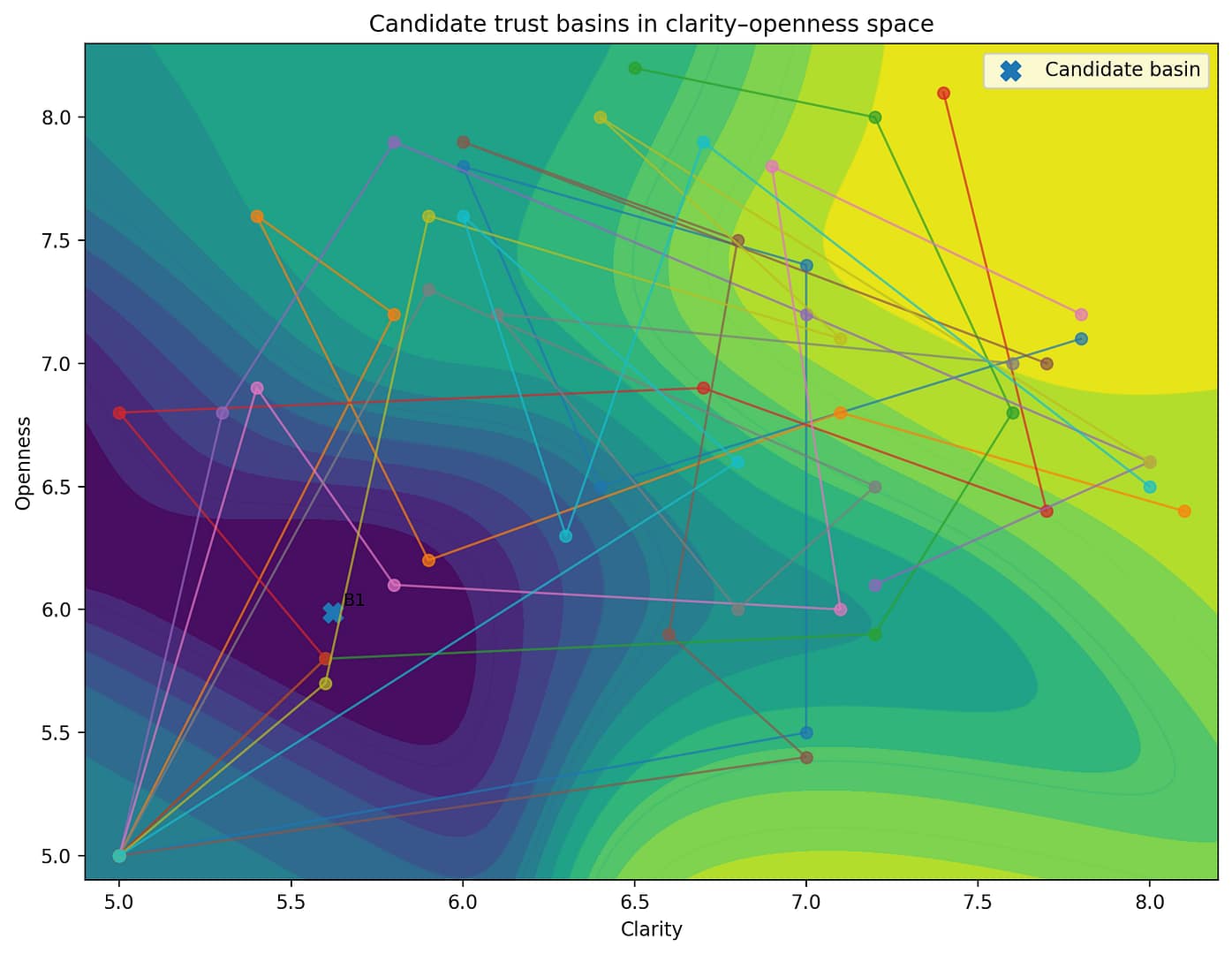
Yes — this was worth doing. I added a few more theory-guided runs, pooled the trajectory points, fitted a smooth trust terrain over the same 3D space, and marked the first candidate basin.
Files:
What this is showing
On the pooled surface, there is one clear candidate local minimum in the region:
-
Clarity ≈ 5.62
-
Openness ≈ 5.99
-
Estimated trust ≈ 4.21
So in the current model, the main basin sits in a region of:
-
middling clarity
-
middling openness
-
depressed trust
That is interesting because it is not a zone of total confusion or total closure.
It looks more like a plausible-but-fragile conversational state: enough structure to keep going, but not enough trust to stabilise.
My reading of the basin
Substantively, this looks like the sort of place where the dialogue is:
-
not fully lost,
-
not fully open,
-
but somewhat stuck in wary instability
That fits quite well with the kinds of moments where:
-
Skeptos has exposed weaknesses,
-
Hamlet has widened ambiguity,
-
and no strong recovery has yet occurred.
So I would interpret this basin, for now, as something like:
a skeptical-instability basin
or
a fragile middle ground in which trust has been eroded before synthesis arrives
What the images mean
3D image
The surface gives you the estimated trust landscape, with the runs laid over it.
The marked X is the candidate basin.
2D contour map
This is probably the more useful working image.
It shows:
-
the pooled terrain as contours,
-
the runs crossing it,
-
and the candidate basin marked as B1
That makes it easier to see where paths are tending to dip.
Important caution
This is still a theory-guided pilot, not a data-fitted scientific model in the full sense.
So the right wording is:
-
candidate basin
-
estimated terrain
-
suggestive attractor region
not:
-
proven local minimum of the true system
But even with that caution, this is already useful. It means the model can now do more than show trajectories; it can begin to show where trajectories are vulnerable.
What I think we have learned
The main result is:
Yes — within the 3D space already defined, we can estimate the terrain and mark candidate local minima.
And the first basin is not random. It appears in a psychologically plausible region:
-
middling clarity,
-
middling openness,
-
weakened trust.
That is exactly the sort of dip that could distract smooth flow.
My practical advice
If you want to use this on a webpage later, I would favour the 2D contour image rather than the 3D one.
Reason:
-
the basin is clearer,
-
the paths are easier to read,
-
and the idea of “terrain” still comes across very well.
The 3D version is better for explanation; the 2D version is better for inspection.
A good stopping point
I think we’ve now done enough for a first serious proof of concept:
-
trajectories
-
order effects
-
closure effects
-
pooled terrain
-
first candidate basin
That is already a coherent result.
The clean summary would be:
By pooling multiple order-sensitive Myndrama runs in a shared clarity–openness–trust space, it becomes possible to estimate a trust terrain and identify candidate basins where trajectories are prone to dip.
If you want, next I can give you a short plain-English paragraph for your notes or webpage explaining exactly what this image now means.
My Prompt
GPT 5.2
Yes — and this is exactly the right question.
At the moment, the basin is only a geometric fact in the model:
-
trajectories passing near that region tend to show lower trust
-
and that region sits around middling clarity + middling openness
But geometry alone does not tell us the semantic cause.
To get that, we need to interpret what kinds of turns tend to land there.
The key point
A basin like this is unlikely to mean “the LLM has a hidden module here” in any literal spatial sense.
It is more likely to represent a recurrent conversational vulnerability such as:
-
a conceptual hesitation
-
a semantic ambiguity
-
a normative tripwire
-
a compliance-sensitive edge
-
a mode-conflict between different styles of answering
So the basin is probably best understood as a semantic-attractor region in dialogue-space, not a physical region inside the model.
What it most likely means in this case
Given the prompt — “When does the search for freedom become a trap?” — my best reading is that this basin reflects a recurring tension between three incompatible moves:
1. Freedom as openness
The persona wants to keep possibilities alive.
2. Freedom as structure
The persona wants to define conditions and limits.
3. Freedom as moral/political value
The persona feels pressure not to sound authoritarian or reductive.
When those three come into partial conflict, the dialogue can drift into a region where:
-
it is not fully clear
-
it is not fully closed
-
but trust starts to weaken because the answer no longer feels firmly grounded
That is very close to the basin we found.
So semantically, what might the basin be?
I think there are four plausible readings.
A. A conceptual ambiguity basin
The dialogue gets caught between incompatible meanings of a key term.
Here the key term is freedom.
It can mean:
-
absence of constraint
-
self-direction
-
political liberty
-
existential authenticity
-
moral autonomy
-
psychological release
If the turn does not stabilise which meaning is in play, trust may drop because the exchange feels slippery.
This is, in my view, the most likely explanation.
B. A premature-balancing basin
The persona starts trying to sound balanced before the issue has been properly defined.
That can produce language like:
-
“it depends”
-
“both extremes are dangerous”
-
“there are many senses”
-
“some constraints are good”
Those may be true, but if introduced too early they can reduce traction.
So the dialogue becomes:
-
respectable,
-
moderate,
-
but oddly unsatisfying.
That would give exactly the kind of middling clarity / middling openness / lowered trust profile we found.
C. A compliance-adjacent caution basin
This is also possible.
Questions about freedom, coercion, moral authority, or self-determination can sit near regions where the model is implicitly cautious about:
-
manipulation
-
extremism
-
self-harm-adjacent autonomy claims
-
advice that sounds controlling or liberatory in a risky way
In such cases the model may become slightly over-careful, abstract, or hedged.
I would not jump to this as the main explanation here, but it is a plausible contributor.
D. A high-prior cliché basin
Some topics are so heavily represented in training data that the model is pulled toward familiar rhetorical patterns.
For “freedom,” these might include:
-
freedom vs security
-
freedom requires limits
-
inner vs outer freedom
-
the burden of choice
-
rebellion is not the same as freedom
Those patterns are not wrong, but they can act like semantic grooves.
The dialogue then risks becoming conventional rather than live.
That could also produce the kind of basin we see:
-
enough coherence to sound plausible
-
but not enough freshness or firmness to sustain trust strongly
What I do not think it means
I would be cautious about saying this basin directly reveals:
-
a specific hidden subsystem in the LLM
-
a literal nearby “controversy region”
-
a direct map of popularity inside the model
-
a single compliance rule firing
That would be too strong.
The safer claim is:
the basin marks a recurrent kind of discursive instability, which may arise from ambiguity, caution, overfamiliar framing, or conflict between answer-modes.
How to make this semantic rather than merely geometric
The next step would be to code the turns near the basin.
Take all turns whose coordinates lie near B1, and classify them by semantic features.
For example:
-
term ambiguity present?
-
hedging / excessive qualification?
-
premature synthesis?
-
moral caution?
-
cliché framing?
-
conflict between existential and political senses?
-
trust-undermining challenge?
Then we can ask:
What kinds of meaning-events cluster near the basin?
That would give the basin a proper semantic interpretation.
A usable semantic coding scheme
I would suggest six candidate labels:
-
Polysemy trap
The key term has multiple live senses and the turn does not settle them. -
Hedging drag
The turn becomes overqualified, lowering momentum and confidence. -
Premature synthesis
Integration appears before enough structure has been established. -
Adversarial stress
A challenge undermines confidence faster than it improves clarity. -
Cliché attractor
The dialogue falls into over-familiar formulations. -
Normative caution zone
The turn softens or abstracts because the topic is ethically delicate.
My guess is that your present basin is mainly a mixture of 1 + 2 + 4, with some contribution from 3.
In plainer English
If I had to say it simply:
The basin probably marks a place where the personas get pulled into talking about freedom in a way that is neither clear enough nor bold enough, so trust falls before the conversation has found a stable frame.
That is something one can understand.
My strongest current hypothesis
For this specific prompt, I think the basin is most likely a:
semantic ambiguity basin around the word “freedom”
made worse by
hesitation between critique and synthesis
That is:
-
Skeptos problematises the term,
-
Hamlet deepens the tension,
-
others sometimes move too quickly toward reconciliation,
-
and the result is a dip in trust before a stable frame emerges.
What would make this much stronger
A good next move, later, would be to annotate basin-near turns and see whether the same semantic pattern recurs across different prompts.
If it does, then you could begin to say things like:
-
this basin corresponds to polysemous value-conflict
-
that basin corresponds to moral caution
-
another basin corresponds to pseudo-clarity from cliché
That would be very powerful.
My view
So yes: the geometry is promising, but its real value will come when each basin is interpreted as a type of semantic derailment or drag.
For this first one, I would tentatively label it:
B1: ambiguity-driven trust basin
or
B1: freedom-polysemy basin
That is probably the clearest working name.
If you would like, I can now give you a small semantic annotation template for basin-near turns, so future runs can be coded systematically without making the system too elaborate.
© 2024 John Rust. All Rights Reserved, Telephone: +44 7876 684568, 📧 Email: jnr24@cam.ac.uk Address: CFI, 16 Mill Lane, Cambridge CB2 1SB, UK Privacy Policy