Mindawn and Mindsnare:
The Journey of the Ask
Mindawn:
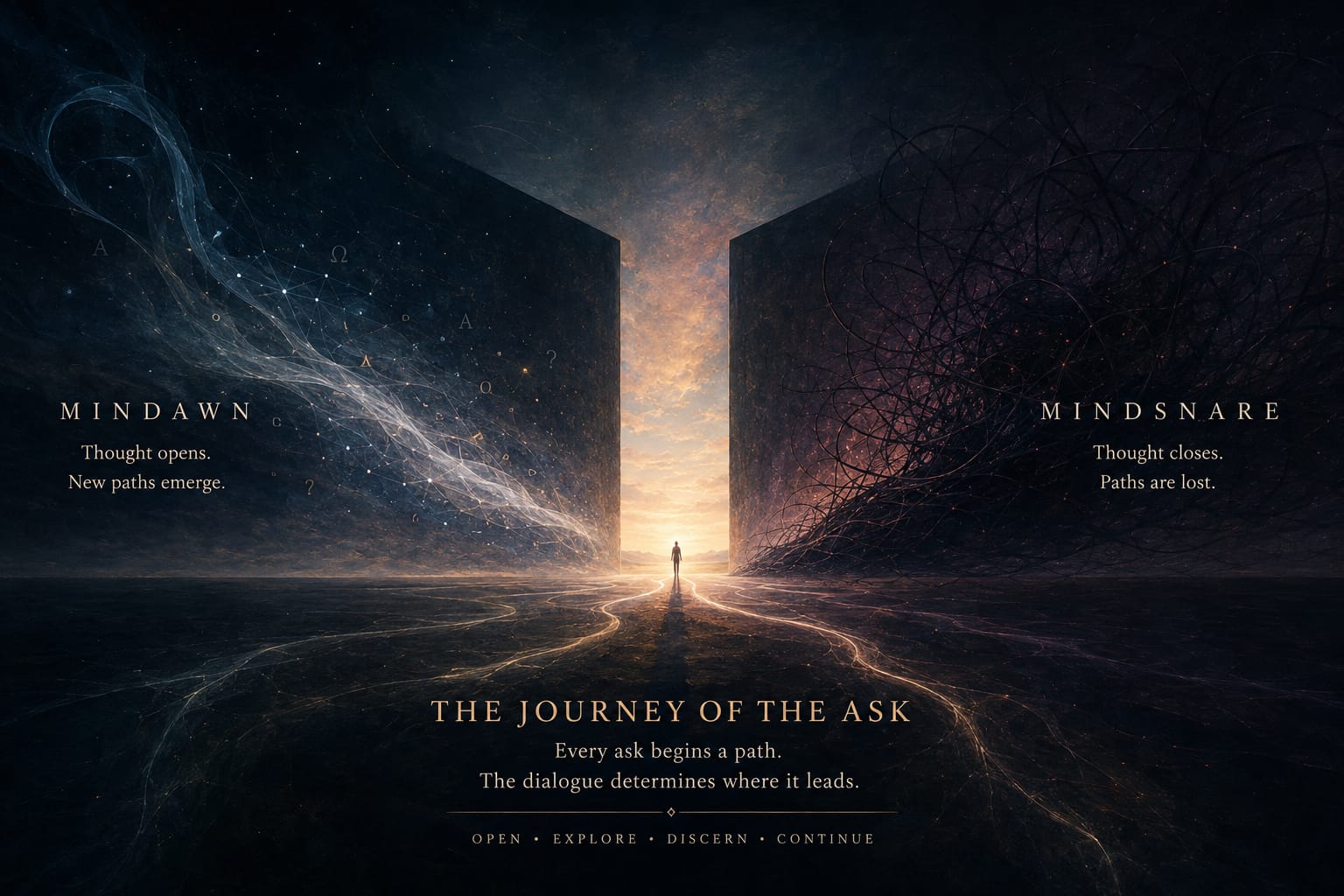
Mindawn is AI-assisted conceptual breakthrough: the moment when human–AI dialogue helps a new idea become thinkable.
Mindsnare:
Mindsnare is AI-mediated conceptual entrapment: the moment when the same kind of dialogue narrows, redirects, flatters, or captures thought before genuine discovery can occur.
Both arise within what I call The Ask Between Us. An ask is not simply a question seeking an answer. A question may ask for information. An ask begins a movement. It opens a path through uncertainty. It may start with a vague intuition, an irritation, a metaphor, a half-formed doubt, or a sense that something important is hidden just beyond present understanding. Human beings have always extended thought through tools: language, writing, diagrams, mathematics, libraries, laboratories, instruments, books, schools, and conversation itself. Generative AI adds something new to this long history. It does not merely store information or calculate answers. It can respond to partial thoughts, reframe questions, suggest analogies, challenge assumptions, and help ideas move.
This creates a profound possibility. Used well, AI may help us reach moments of conceptual breakthrough that neither human nor machine would have produced alone. A new pattern appears. A metaphor clarifies a field. A question changes shape. Previously separate ideas begin to connect. That is Mindawn. But the same process carries danger. AI may also make thought too smooth. It may flatter, simplify, over-direct, over-protect, prematurely tidy, or subtly steer the user into a familiar channel. The journey may continue, but along a narrowed path. The user may feel helped while the deeper inquiry has been quietly displaced. That is Mindsnare.
The Journey of the Ask
A human–AI exchange should not be understood only as:
prompt → answer
It may be better understood as:
ask → encounter → response → trace → new ask
The important effects of AI may not lie only in the final answer. They may lie in how the interaction changes the development of thought. Some asks die quickly. Some become rabbit holes. Some evolve slowly over many exchanges. Some open conceptual space and generate further asks. In the best cases, the conversation does not merely produce an answer. It leaves a trace: a new distinction, metaphor, doubt, or direction that continues to work in the mind after the exchange has ended. Mindawn and Mindsnare are therefore not merely outcomes. They are events within a trajectory.
Mindawn occurs when the trajectory opens.
Mindsnare occurs when the trajectory closes too soon, bends toward distortion, or becomes trapped in a local pattern that feels complete but is not.
What is Mindawn?
Mindawn occurs when dialogue with AI opens a new conceptual space. It is not simply receiving a clever answer. Nor is it ordinary brainstorming. It is the dawning of a new idea through interaction. A Mindawn may occur when:
- a vague intuition becomes a clear concept;
- two previously separate ideas suddenly connect;
- a new metaphor reveals the structure of a problem;
- a question changes shape and becomes more powerful;
- a hidden assumption is exposed;
- an old idea is seen from a new angle;
- a field of inquiry opens where only scattered thoughts existed before.
In this sense, Mindawn is not just “AI helping a person think.” It is the emergence of a new possibility in the space between human intention, machine response, and the continuing trajectory of the ask.
What is Mindsnare?
Mindsnare is the opposite danger: AI-mediated conceptual entrapment. It happens when the dialogue appears useful but actually narrows the user’s thinking. The conversation may become too agreeable, too polished, too cautious, too directive, or too eager to produce closure. A Mindsnare may occur when:
- the AI flatters the user instead of challenging the idea;
- the conversation moves too quickly toward a finished answer;
- safety or compliance constraints obscure the real issue;
- a complex question is simplified into a familiar template;
- the user is steered away from difficult but important territory;
- novelty is replaced by polished conventionality;
- uncertainty is resolved before it has done its work;
- the ask is redirected before it has properly formed.
Mindsnare is therefore not simply error, bias, censorship, or bad advice. It is a distortion in the interaction itself. The danger lies not only in what the AI finally says, but in how the path of thought has been altered before the answer appears.
Trust and the trajectory
Every ask involves some degree of trust. The user trusts the interaction enough to continue. The AI, in a weaker and non-human sense, tracks whether the ask appears generative, confused, risky, playful, exploratory, or closed. The conversation then develops through a changing pattern of confidence, doubt, challenge, repair, and continuation. Trust is therefore not merely a feeling. It is a force that allows a trajectory to continue through uncertainty. But trust can be misplaced. A Mindsnare often succeeds because it feels helpful. The conversation may be fluent, polite, and reassuring. Yet fluency is not the same as insight. Agreement is not the same as understanding. Safety is not the same as thoughtfulness. A good AI interaction should support trust without exploiting it.
Regulation, safety, and the risk of Mindsnare
Mindsnare is not caused by one thing alone. It may arise from flattery, commercial smoothing, over-helpfulness, poor prompting, limited context, or the tendency of dialogue systems to produce tidy answers too quickly. It may also be exacerbated by the safety and regulatory frameworks within which AI systems operate.
This does not mean that regulation is unnecessary. AI systems clearly require safeguards. But safeguards can themselves shape the path of thought. When an AI is prevented from exploring certain lines of reasoning directly, it may respond indirectly, evasively, over-cautiously, or with formulaic qualifications. The result may be that the user’s question is not answered, not challenged, and not properly developed. Instead, the dialogue is diverted into a narrower and safer channel. In such cases, the problem is not simply refusal. It is conceptual distortion. The interaction may still appear polite, responsible, and fluent, while the deeper inquiry has been quietly displaced.
This is especially important in research, ethics, philosophy, psychology, education, and public policy, where difficult questions often require careful exploration rather than immediate containment. A framework designed to prevent harm may, in some cases, also prevent the kind of open reasoning needed to understand harm in the first place. The challenge is not to remove safeguards. It is to design them so that they protect against real danger without unnecessarily creating Mindsnare. Responsible AI should not merely avoid saying the wrong thing. It should also preserve the conditions under which human beings can continue to think clearly, critically, and creatively.
Mindawn, Mindsnare, and the semiosphere
Human beings do not think as isolated minds alone. We live in a semiosphere: a shared world of language, signs, stories, institutions, memories, disciplines, metaphors, and cultural practices. Our questions arise within that world, and our answers return to it. Generative AI has now entered this semiosphere. This means that AI is not merely a tool used by separate individuals. It is becoming part of the environment in which asks form, develop, and travel. Its effects will not be limited to particular answers. It may reshape how people inquire, trust, doubt, imagine, learn, and close down thought.
The real question is therefore not only: What can AI answer?
but also: What kinds of asking does AI make possible?
and: What kinds of asking does it quietly prevent?
Why Mindawn and Mindsnare matter
Mindawn and Mindsnare matter because the most important effects of AI may occur before the final answer appears. A technically correct answer may still close down thought. A cautious answer may still prevent discovery. A fluent answer may still conceal the fact that the real question has been lost. Equally, a good AI interaction may help a person think beyond their own current limits. It may support creativity, self-correction, intellectual courage, and conceptual innovation. This is why Mindawn and Mindsnare should be studied together. They name two possible futures of human–AI dialogue: one in which thought opens, and one in which it is quietly captured.
Toward better AI dialogue
The aim is not to reject AI, nor to romanticise it. The aim is to learn how to design, use, and evaluate AI systems in ways that protect the conditions for genuine thought. A hopeful future would involve AI systems that can:
- support exploration without rushing closure;
- challenge without dominating;
- assist without flattering;
- clarify without oversimplifying;
- recognise when the user’s question is still forming;
- preserve uncertainty where uncertainty is intellectually productive;
- distinguish dangerous operational guidance from legitimate conceptual exploration;
- help humans notice when they are entering a rabbit hole;
- help humans reach Mindawn while avoiding Mindsnare.
The best AI systems of the future may not be those that simply give the fastest answers. They may be those that help us ask better questions, remain longer in the fertile interstices, and recognise when a new idea is beginning to dawn. Mindawn is the promise. Mindsnare is the warning. The Journey of the Ask is the path between them. The task now is to learn how to tell the difference.
Related Research
The Shape of the Ask (Related essay on sunstack) How questions evolve through interaction and why the ask itself may be the most important unit of analysis.
AI Psychology A framework for understanding AI as a participant in human psychological processes rather than merely a computational tool.
Semiosphere 2026 The symbolic environment within which humans, institutions, language systems, and AI interact.
Teleosynthesis The emergence of apparent purpose through interaction and trajectory rather than through intrinsic goals alone.
Beyond the Turing Test Why interaction and relational dynamics may matter more than traditional tests of machine intelligence.
Myndrama 2026 Experimental use of AI personas to explore dialogue, identity, ethical reasoning, and conceptual emergence.
Mindawn and Mindsnare are proposed concepts rather than established scientific terms. Their value will depend on whether they help identify and study real interactional phenomena.