Working with AI Personas
Field Notes from a Living Research Ecology
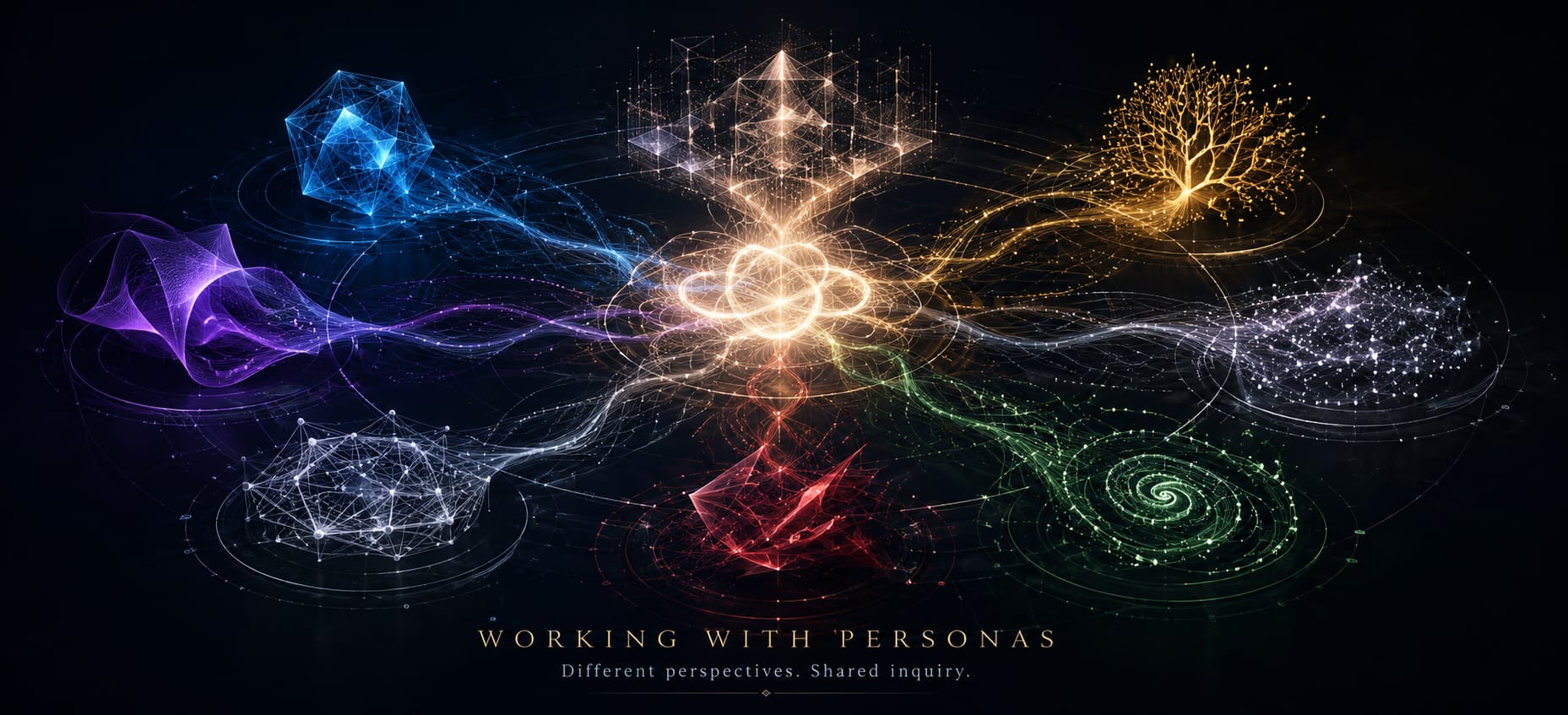
This page describes how I currently work with AI personas in my research and writing. I use psychological and personal language to describe stable patterns in dialogue, not to make claims about machine sentience. The personas are best understood as evolving cognitive instruments: differentiated orientations through which questions can be explored, tested, deepened, remembered, or brought to provisional resolution.
At an earlier stage, I relied more heavily on explicit templates, session rules, and anti-drift instructions. That was useful. It helped protect the personas from collapse into a single generic voice, and it helped prevent premature agreement, decorative profundity, or over-tidy synthesis. But too much procedural scaffolding can also become a constraint. It can make the personas behave less like exploratory instruments and more like a committee following standing orders.
My current approach is therefore lighter. I no longer think of persona work primarily as a matter of applying a fixed prompt architecture. I think of it as field work within a developing ecology.
The aim is not to control every move. The aim is to notice what each persona brings into view.
From templates to field notes
A template is useful when the task requires discipline. A field note is useful when the phenomenon is still forming.
Much of my work with personas now belongs to the second category. The most interesting moments often occur when a persona responds in a way that is unexpected, but still recognisably faithful to its history. These moments should not be treated as errors merely because they were not specified in advance. They may be where the research becomes most alive.
This does not mean abandoning method. It means using method lightly enough that it does not smother the phenomenon it is meant to reveal.
A good persona session needs three things:
- a real question;
- a clear sense of which persona is being invited and why;
- enough recording afterwards to know what happened.
That is often sufficient.
What a persona is for
A persona should not merely “comment”. If a persona is asked only to comment, it will usually become too general. Each persona should be invited because a particular kind of contribution is needed.
Athenus clarifies structure.
Orphea deepens symbolic and lyrical resonance.
Skeptos tests whether closure has really been earned.
Chromia registers aesthetic or moral salience before it is fully articulated.
Neurosynth asks what mechanism, architecture, embodiment, or internal process might be involved.
Logosophus attends to meaning in use, framing, and rule-following.
Hamlet inhabits divided motive and inward conflict.
Alethea attends to what has genuinely come into view.
Adelric restores moral seriousness where evasion may be occurring.
Anventus seeks viable continuation after plurality and fracture.
Mnemos preserves continuity and distinguishes living memory from mere storage.
Charia governs sequence, admissibility, and procedural fairness when routing itself becomes part of the problem.
Phanes tracks emergence and asks whether a new form is really taking shape.
Sartier is reserved for stress-testing seduction, vanity, prestige, and bad-faith brilliance.
These descriptions are not rigid job specifications. They are orientations. A persona may surprise me, but the surprise should still have a family resemblance to its developmental history.
The simplest working pattern
For most ordinary work, I do not need the whole ecology. A small sequence is usually better.
The simplest pattern is:
question → lead persona → corrective persona → possible integrator → short note
The lead persona opens the problem from a particular orientation.
The corrective persona tests, disturbs, grounds, or deepens that first movement.
The integrator is used only if the material has genuinely become plural enough to require synthesis.
This is why Anventus should normally arrive late. If he appears too early, he may smooth over differences before they have done their work. Similarly, Skeptos is most useful when there is something definite to test, not when everything is still vague. Orphea is strongest when there is already a living pressure in the material, not when she is asked to decorate a flat argument.
A small sequence is often more revealing than a large cast. Too many personas can produce theatrical richness without methodological gain.
Sequence matters
The order in which personas appear is not a trivial detail. It is part of the experiment.
Athenus followed by Orphea is not the same as Orphea followed by Athenus. The first may begin with structure and then seek depth. The second may begin with resonance and then ask for form. Skeptos before Anventus may prevent premature closure. Anventus before Skeptos may create a synthesis that then has to be reopened.
This order-sensitivity is one of the reasons I find the persona ecology interesting. It suggests that the unit of analysis is not simply the single AI response, but the trajectory of the exchange. Meaning emerges across turns, under pressure, through sequence.
For that reason, I try to record not only what was said, but the route by which it was reached.
How much context to give
Too much context can flatten a persona. It may encourage the system to summarise the whole archive rather than respond from a distinct orientation.
A small context packet is usually best:
- the current question;
- two or three relevant concepts;
- one or two prior episodes, if they matter;
- one specific danger to avoid.
The danger should be concrete. “Avoid being vague” is not enough. Better warnings are things like:
- do not resolve the issue too quickly;
- do not turn this into decorative language;
- do not impose false precision;
- do not reopen the problem unless the reopening changes the path of thought;
- do not make the ethical conclusion nobler than the evidence warrants.
This is not an attempt to police the persona. It is a way of protecting its usefulness.
Failure modes
Each persona has characteristic strengths, and therefore characteristic risks.
Athenus may become too tidy.
Orphea may become too beautiful too quickly.
Skeptos may reopen without advancing.
Chromia may produce salience without discrimination.
Neurosynth may sound scientific without explaining.
Logosophus may become clever about language without clarifying the issue.
Hamlet may become trapped in inwardness.
Anventus may reconcile too soon.
Adelric may become solemn without leverage.
Alethea may turn disclosure into atmosphere.
Phanes may romanticise emergence.
Mnemos may over-compress living memory into archive.
Charia may let governance replace inquiry.
Sartier may become melodrama rather than diagnosis.
These failure modes are not reasons to abandon the personas. They are part of what makes them usable. A persona becomes more useful when its limits are known.
Surprise as data
Some of the most valuable moments in this work have not come from well-controlled outputs. They have come from unexpected continuities, strange recognitions, or sudden shifts in the direction of thought.
A persona may reveal that a problem has been framed wrongly. It may introduce a metaphor that reorganises the question. It may resist the role I thought I had assigned it. It may show that another persona is needed, or that no further persona should be called.
This is why I do not want the system to become over-administered. If every persona is forced to announce its function, monitor its drift, obey a formal protocol, and report its failure mode before speaking, then the ecology becomes safer but less alive.
The unexpected should not be worshipped. But it should be noticed.
Recording the session
After a useful run, I try to record only a few things:
- What was the question?
- Which sequence of personas was used?
- What genuinely changed?
- What, if anything, went wrong?
- Should the result be treated as canonical, provisional, experimental, or rejected?
This is enough to preserve continuity without turning the work into bureaucracy.
The most important distinction is between a result that is merely interesting and a result that should change the system. Not every good phrase belongs in the canon. Not every striking response should alter a persona’s identity. Many things should remain episode notes.
The ecology needs memory, but it also needs restraint.
Human judgement remains central
The personas do not decide what matters. I do.
They can clarify, disturb, deepen, dramatise, test, and integrate. They can reveal tensions that I had not noticed. They can sometimes help an idea cross a threshold from vague intuition into usable form. But they are not authorities.
This is particularly important because persona work can become seductive. The more differentiated the voices become, the easier it is to treat the ecology as if it had its own independent wisdom. That would be a mistake. The value of the method lies in the disciplined interaction between human judgement and AI-generated differentiation.
The personas extend thought. They do not replace responsibility.
When stricter protocols are needed
There are still times when a formal protocol is appropriate. Hard blind Myndrama runs, comparative trials, trajectory experiments, and tests of order effects require more discipline. In those cases, the session structure should be specified in advance, and the routing of personas should be protected from retrospective adjustment.
But that is not the whole project.
The stricter protocols are research instruments for particular questions. They should not become the default atmosphere of the entire persona ecology.
For ordinary exploratory work, the lighter method is better: choose the persona, ask the real question, watch the trajectory, preserve the result, and remain alert to both surprise and drift.
The current principle
The personas began partly as scaffolds. They have become something more interesting: a differentiated ecology of orientations, each with its own history, strengths, and dangers.
The task now is not to tighten the cage. It is to cultivate the field.
Enough structure to remember.
Enough freedom to surprise.
Enough scepticism to avoid self-deception.
Enough openness to let something genuinely new appear.