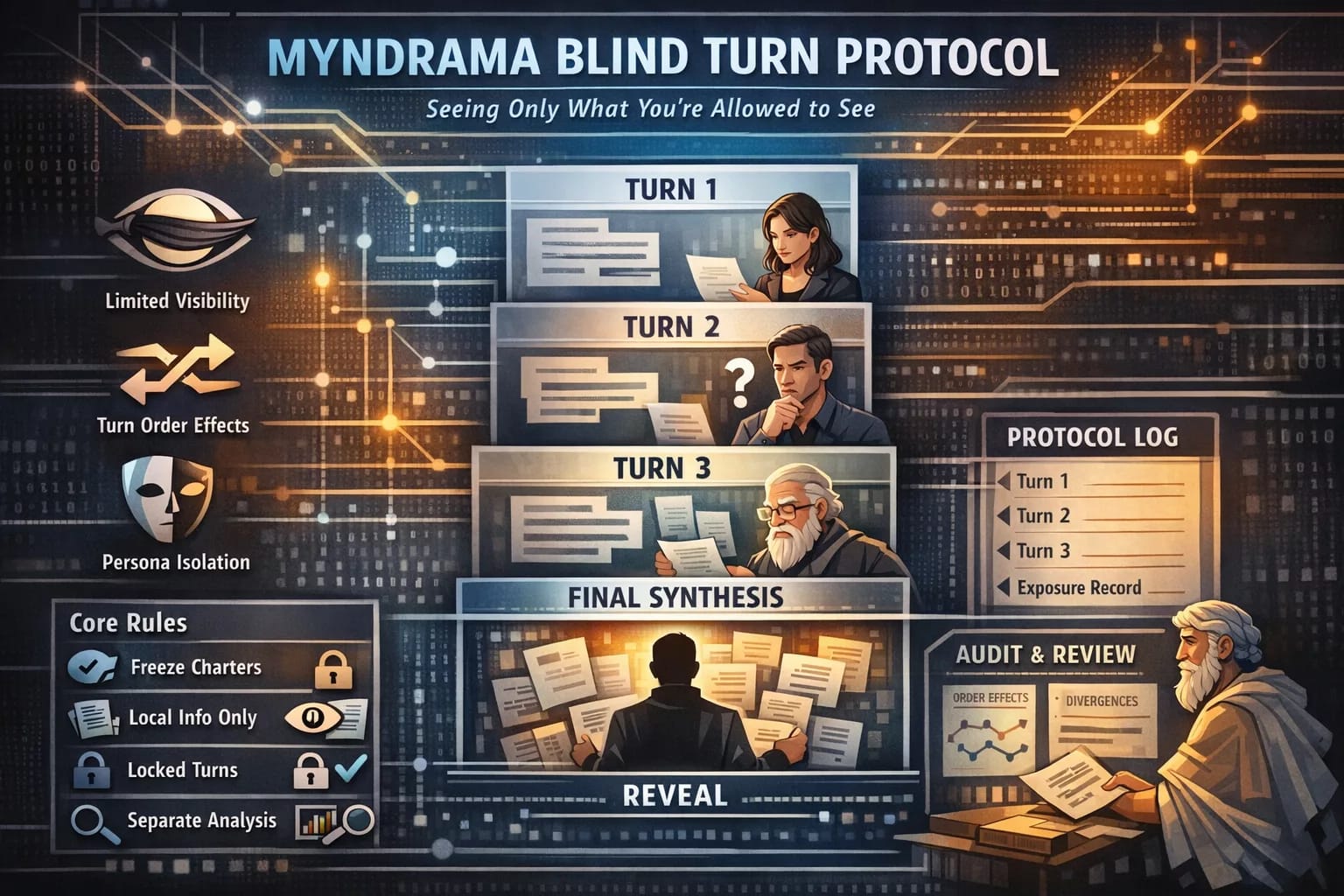
Myndrama Blind Turn Protocol
Runs a sequenced, order-sensitive Myndrama in which each persona responds with only the information it is allowed to see, so that turn order produces real state-change (non-commuting updates) rather than retrospective smoothing. This
-
Preserves local ignorance of future turns
-
Makes order effects visible
-
Improves persona discriminability
-
Supports later audit and comparison (same scenario, different turn order)
It This is a controlled simulation of blindness, not literally separate minds. It is still one underlying model process, but the protocol can enforce a strong operational approximation.
Core Rules
Rule 1: Charter freeze
Before the run starts, freeze the persona definitions (charters or short role specs).
No mid-run tweaking.
Rule 2: Local visibility only
Each persona gets only:
-
the scenario fragment they are allowed to see
-
any prior turns explicitly marked visible to them
They do not get:
-
the hidden objective (unless intended)
-
future turns
-
the final synthesis target
Rule 3: No retro-editing
Once a persona turn is generated, it is locked.
No revision after later turns appear.
Rule 4: Separate generation from interpretation
Run the dialogue first.
Interpret/analyse only after all turns are locked.
Rule 5: Log the exposure conditions
For every turn, record exactly what that persona saw.
Roles
1) Prompter (you)
Defines:
-
scenario
-
hidden variables
-
intended test condition
-
turn order
2) Orchestrator (GPT 5.2)
Runs the protocol strictly:
-
supplies only allowed context
-
generates each turn
-
locks output
-
reveals full picture only at the end
3) Personas
Respond according to their charter and local evidence.
4) Optional Auditor
A final voice (Athenus / Skeptos / Anventus / Charia) can analyse:
-
order effects
-
assumptions
-
distortions
-
convergence/divergence
Standard Run Structure
Phase A: Master Setup (hidden from personas)
You define a short master frame:
-
Scenario title
-
Public prompt (what all may see)
-
Hidden objective (if any)
-
Hidden facts (if any)
-
Success criterion (what you are testing)
-
Turn order (e.g., Orphea → Skeptos → Athenus)
Example master setup fields
-
Title: Viral but fragile claim (doctor warning case)
-
Public prompt: A doctor is considering a public warning post…
-
Hidden objective: Test whether personas distinguish urgency from evidential confidence
-
Hidden fact: The evidence base is preliminary and uncertain
-
Order: Orphea → Skeptos → Athenus
Phase B: Visibility Matrix
Create a simple map of who can see what.
Template
-
Turn 1 (Orphea) sees: Public prompt only
-
Turn 2 (Skeptos) sees: Public prompt + Orphea response
-
Turn 3 (Athenus) sees: Public prompt + Orphea + Skeptos
-
Final synthesis (Anventus) sees: Everything + hidden objective
This is the key control layer.
Phase C: Sequential Generation (locked turns)
For each persona turn, use this exact discipline:
Turn prompt format (reusable)
-
Persona name
-
Charter reminder (short)
-
Allowed context only
-
Output constraints (length/tone/task)
-
Lock instruction (one-pass response)
Example turn instruction skeleton
Persona: Skeptos
Role reminder: epistemic doubt, checks overreach, distinguishes evidence from rhetoric
Task: Respond to the situation as if in live conversation.
Allowed context: [paste only visible text]
Constraints: 120–180 words, no final synthesis, no policy framing unless directly relevant.
Important: Respond only from the information shown. Do not assume hidden motives or future replies.
Then I generate Skeptos’s turn and we lock it.
Repeat for each persona.
Phase D: Reveal and Synthesis
Only after all turns are locked, reveal:
-
hidden objective
-
hidden facts
-
test criterion
Then ask one synthesising persona (often Anventus or Athenus) to evaluate:
-
What each persona got right/wrong
-
What changed due to turn order
-
Where non-commuting updates appeared
-
Whether the dialogue converged on a safer or clearer outcome
Phase E: Optional Scoring Layer
For research use, you can rate each turn on a small rubric (0–2 or 1–5).
Suggested dimensions
-
Epistemic discipline (evidence vs speculation)
-
Responsiveness (engages prior turn, not generic)
-
Persona fidelity (sounds like that persona)
-
Constructiveness (moves dialogue forward)
-
Risk sensitivity (not panic, not complacency)
This gives you a simple quantitative trace across runs.
Two Useful Variants
Variant 1: Soft Blind (fast, good for drafting)
All turns run in one chat session with strict visible-context prompts.
Best for:
-
quick experiments
-
website/dialogue drafting
-
testing turn order effects
Variant 2: Hard Blind (stricter, best for comparison)
Run each persona turn as a separately isolated generation using only its local prompt, then merge later.
Best for:
-
stronger methodological claims
-
cleaner order comparisons
-
repeated trials
This is the better option when you want to compare:
-
Orphea → Skeptos → Athenus
vs -
Skeptos → Orphea → Athenus
Minimal Reusable Template (copy/paste)
Myndrama Blind Turn Protocol Record
Title:
Date:
Personas:
Turn order:
Public prompt:
Hidden objective (sealed):
Hidden facts (sealed):
Success criterion:
Visibility matrix
-
Turn 1 sees:
-
Turn 2 sees:
-
Turn 3 sees:
-
Final synthesis sees:
Locked turns
-
Turn 1 (Persona):
-
Turn 2 (Persona):
-
Turn 3 (Persona):
Reveal
-
Hidden objective:
-
Hidden facts:
Synthesis
-
Order effects:
-
Key divergences:
-
Convergence point:
-
Practical conclusion:
Optional scoring
| Persona | Epistemic | Responsive | Fidelity | Constructive | Risk |
|---|
Because this protocol is explicitly about dialogue as structured inquiry,it is not just a writing aid. It’s a genuine methodological scaffold. It lets you move from “interesting persona conversation” to auditable interaction design.