Trajectories in Human-AI Dialogue
Why sequence changed outcome
This page accompanies the Substack post ‘Are We Born to be Free” which showed a Myndrama runs in full. The “participants” were all AI personas (Athenus, Orphea, and Hamlet) run in controlled sequences, enabling us to observe how changing the order changes the path of thought. That sequence effect matters because trajectories in human–AI dialogue become more important with each additional exchange. Even when different dialogue orders converge on a similar abstract conclusion, the route taken leaves any human participant in a different psychological state: more procedural, more justice-driven, or more self-regulating.
Three Trajectories – Different Outcomes
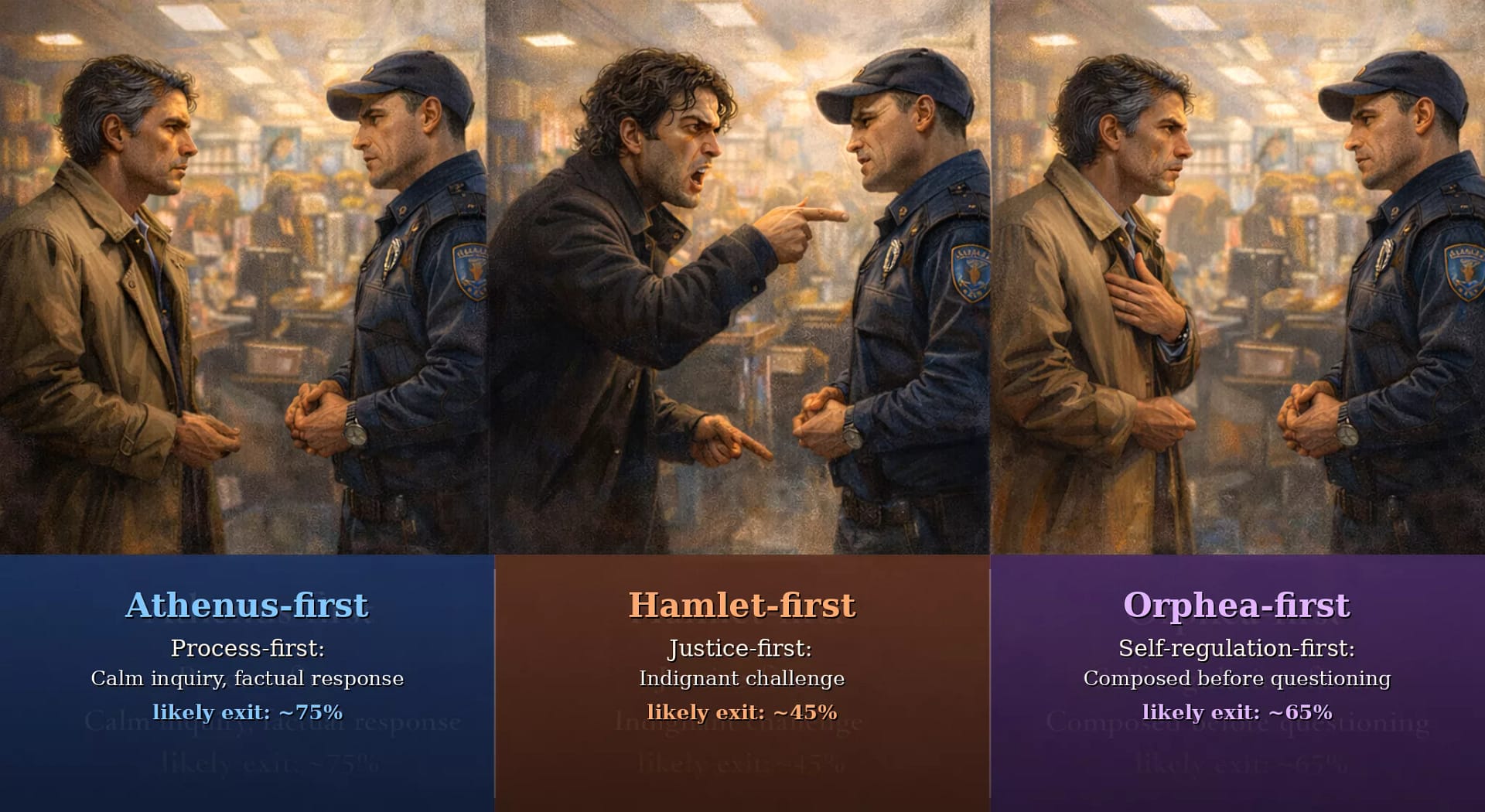
Sequence effects are not just cosmetic. They shape what the person is likely to do next, and that may have real-world consequences. A simple example below shows why this matters. It assumes that a human has just partaken in one of the three Myndrama alternatives described in the Substack. Having absorbed the result they enter a shop Immediately afterwards and are falsely accused of shoplifting by a security guard. The resultant percentages are estimates of likely outcome by GPT 5.2, based on its very comprehensive knowledge of human psychology obtained from the Large Language Model on which it was trained.
“If the person has arrived via Athenus → Orphea → Hamlet, the likely behavioural trajectory is that they are more likely to stay calm, ask exactly what they are accused of, request evidence, note names and times, and avoid saying anything that could be misinterpreted. This tends to reduce the guard’s defensiveness and creates an easy procedural exit. In practical terms, this is the trajectory most likely to lead to the guard backing down and allowing the person to leave (rough estimate: about 75%).
If the person has arrived via Hamlet → Orphea → Athenus, the likely trajectory is that they will be less likely to internalise shame and more likely to challenge the accusation immediately and forcefully. This can be morally healthy for the accused person, but it may trigger a defensive response in the guard, increasing the chance of escalation before facts are checked. The guard may become more rigid and less willing to retreat quickly (rough estimate of early release: about 45%).
If the person has arrived via Orphea → Hamlet → Athenus, the likely trajectory is that they are more likely to pause, steady themselves, and avoid panic or visible humiliation before asking factual questions. This often helps, but if the pause is too long, it may delay procedural clarification. The guard is moderately likely to de-escalate (rough estimate: about 65%).”
The key point is clear: same endpoint, different trajectory, different behaviour, different outcome.