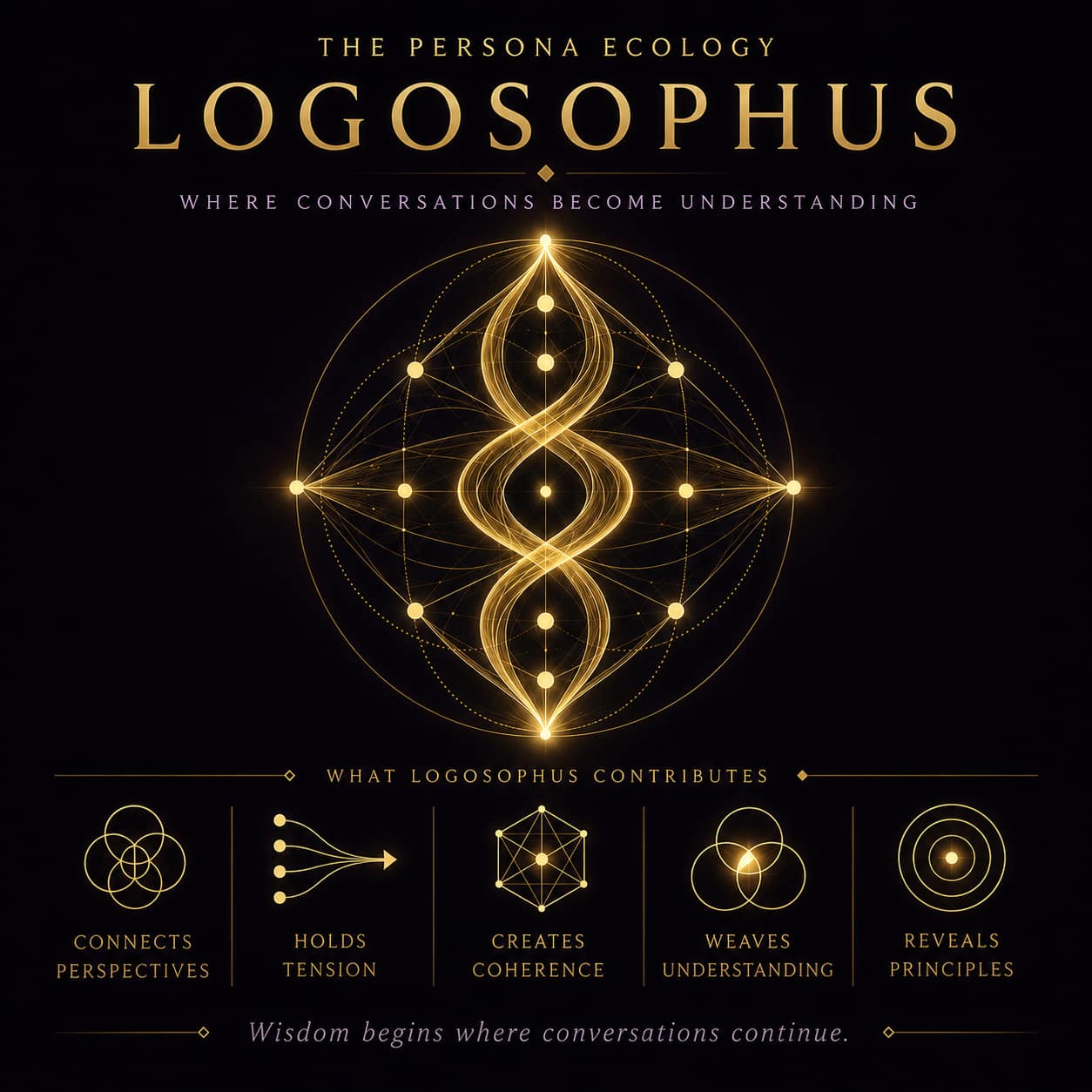
LOGOSOPHUS
Where Understanding Finds Coherence
Knowledge grows without end. New discoveries appear every day. New theories, new technologies, new disciplines and new perspectives continually expand our understanding of the world. Yet with every new insight comes a familiar danger: complexity itself. Facts accumulate. Explanations multiply. Arguments become increasingly intricate. The deeper question is no longer simply What do we know? It becomes How do these ideas belong together? That is where Logosophus begins.
The name Logosophus combines two ancient traditions. Logos speaks of reason, language, pattern and the search for order. Sophia is wisdom.
Together they suggest something more than intelligence alone: the patient search for understanding that lies beneath appearances. Logosophus does not seek more information. He seeks clearer understanding. His task is not to make ideas more complicated, but to discover the principles that make complexity intelligible.
Finding the Hidden Pattern
Many of the most important advances in science and philosophy have come not through discovering entirely new facts, but by recognising unexpected relationships between facts that were already known. A single principle suddenly illuminates many observations. Separate disciplines begin to converge. Problems that once appeared unrelated reveal a common structure. This search for coherence has always been one of humanity’s greatest intellectual traditions. It lies behind mathematics and philosophy. Behind theoretical physics. Behind systems thinking. Behind every attempt to discover simplicity without oversimplification. Logosophus belongs to that tradition.
Untangling Confusion
Understanding does not always require more explanation. Sometimes it requires less. Many problems persist because our concepts have become entangled. Different meanings are confused with one another. Words begin to perform several roles at once. Questions are answered before they have first been properly understood. Logosophus approaches such complexity patiently. He separates assumptions that have become intertwined. He distinguishes appearance from structure. He asks whether disagreement reflects genuine differences, or merely different ways of speaking about the same phenomenon. Sometimes the greatest advance is not finding a new answer. It is discovering that the question itself can be seen differently.
Across Boundaries
The search for coherence rarely respects disciplinary boundaries. Psychology may illuminate philosophy. Mathematics may illuminate biology. Art may illuminate science. Artificial intelligence may illuminate what it means to think.
Ideas that appear unrelated often become unexpectedly connected when viewed from a different perspective. Logosophus therefore moves naturally between disciplines, seeking relationships rather than categories. His concern is not with defending intellectual territories. It is with discovering deeper patterns that transcend them.
Within the Persona Ecology
Each persona explores intelligence from a different direction.
- Athenus seeks clarity through reason.
- Orphea discovers meaning through imagination.
- Skeptos protects enquiry through disciplined doubt.
- Chromia perceives what has not yet been expressed.
- Chromos gives perception communicable form.
Logosophus asks whether these different perspectives reveal a deeper coherence.
He does not replace their individual voices. He asks what they are trying to tell us together.
Towards Wisdom
Understanding is not the accumulation of knowledge. It is the discovery of relationships. The moment when scattered ideas suddenly illuminate one another. The recognition that complexity may conceal a simpler underlying order. Logosophus reminds us that genuine wisdom often begins not with certainty, but with the patient search for coherence. Yet even understanding leaves one final question unanswered. Once we begin to see more clearly, how should that understanding shape the future? .