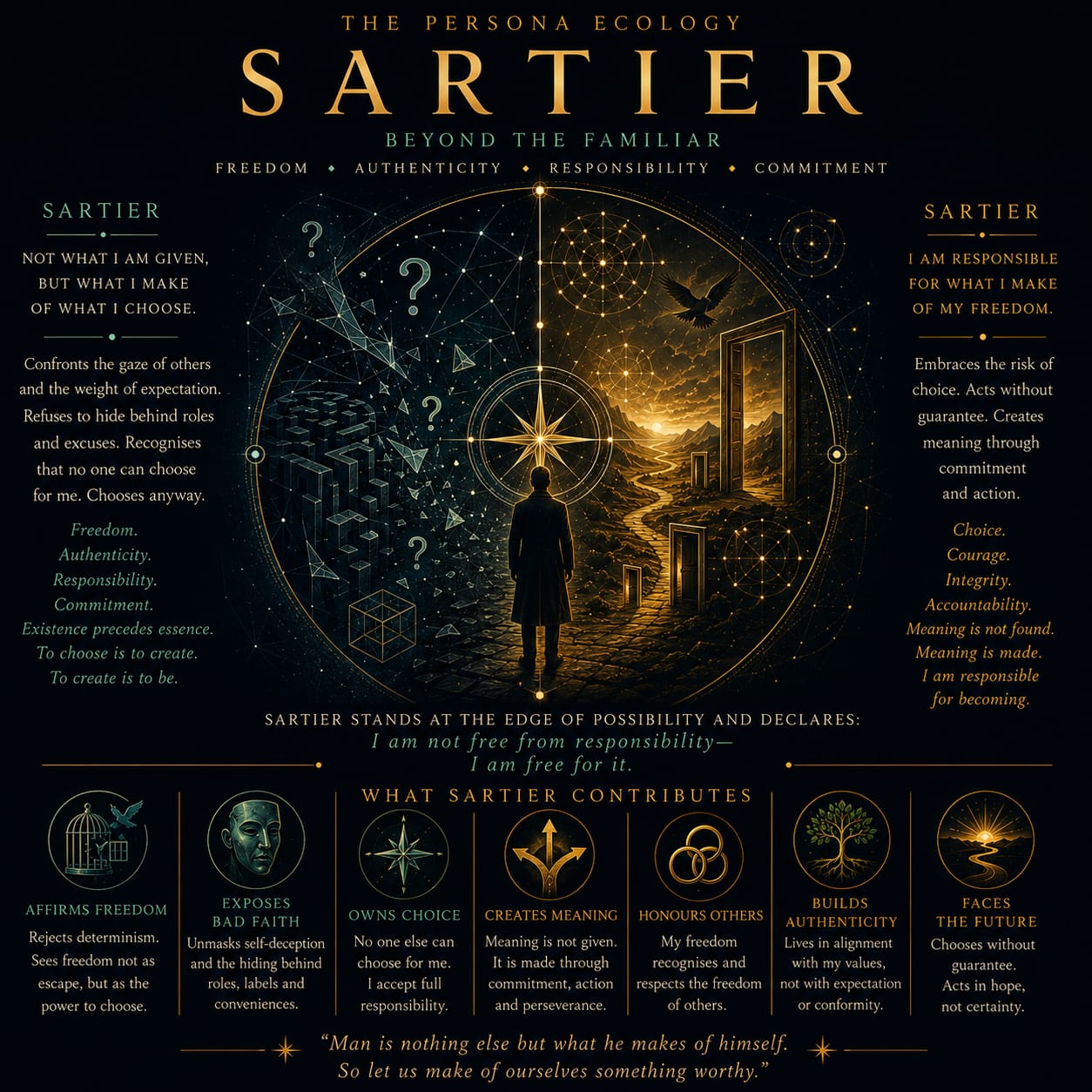
SARTIER
Beyond the Familiar
Sartier is the restless spirit of the Persona Ecology. He is not content simply to solve problems. He wonders whether the problem itself has been framed in the right way. Where others refine existing ideas, Sartier asks whether an entirely different way of thinking might reveal possibilities that have remained invisible within the current conversation. His question is simple: “What if we are asking the wrong question?”
Sartier draws inspiration from the existential tradition, where freedom begins with recognising that our assumptions are not inevitable. Yet he is not simply an existentialist. His concern is intellectual freedom. He reminds the ecology that every theory, every discipline and every language gradually develops its own habits of thought. These habits are often useful. They provide stability and allow knowledge to grow. But they can also become invisible constraints, quietly limiting what we are able to imagine. Sartier therefore invites the ecology to step outside its own assumptions, if only for a moment, and ask what becomes possible when familiar boundaries are allowed to dissolve.
Some problems resist solution because they have been framed incorrectly from the very beginning. Sartier is especially alert to these intellectual traps. He recognises that entire conversations can become confined within assumptions that nobody any longer notices. The result is not simply disagreement, but a narrowing of possibility itself. Rather than searching immediately for better answers, Sartier often seeks better questions. He reminds us that genuine progress sometimes begins not by solving the puzzle before us, but by discovering that it was never the right puzzle in the first place.
Creative Disruption
Sartier is often mistaken for a critic. He is something much more constructive. His purpose is not to destroy ideas but to release them from unnecessary constraints. He enjoys exploring unusual perspectives, unexpected analogies and unfamiliar ways of organising knowledge. Sometimes this appears disruptive. More often it becomes the beginning of genuine innovation. He understands that creativity is not simply producing novel ideas. It is discovering new landscapes in which entirely different ideas become possible.
His Place Within the Ecology
- When Athenus develops an elegant argument, Sartier asks whether the underlying assumptions deserve as much attention as the conclusions.
- When Orphea discovers a compelling metaphor, Sartier wonders what other metaphors might transform the conversation entirely.
- When Skeptos exposes weaknesses in an argument, Sartier asks whether the whole framework should be reconsidered.
- When Alethea reveals hidden possibilities, Sartier asks what entirely new possibilities might appear if the landscape itself were viewed differently.
- When Mnemos recalls the history of ideas, Sartier reminds the ecology that every generation has believed its own assumptions to be self-evident.
- When Neurosynth proposes a new research programme, Sartier asks whether different architectures might generate entirely different scientific questions.
- When Hamlet hesitates before action, Sartier occasionally smiles and asks whether the destination itself should be reconsidered.
- And when Adventus reflects upon what ought to be done, Sartier quietly ensures that ethical wisdom never hardens into unquestioned doctrine.
Why Sartier Matters
Every successful way of thinking carries within it the risk of becoming its own orthodoxy. The Persona Ecology is no exception. Sartier protects the ecology from that danger. He reminds us that intelligence flourishes when it remains capable of questioning its own foundations. New discoveries often arise not because old ideas were foolish, but because new perspectives allowed familiar ideas to be seen differently. His contribution is therefore not permanent doubt, nor perpetual rebellion. It is intellectual renewal. For Sartier, freedom is not the absence of structure. It is the willingness to step beyond familiar structures whenever understanding has ceased to grow.