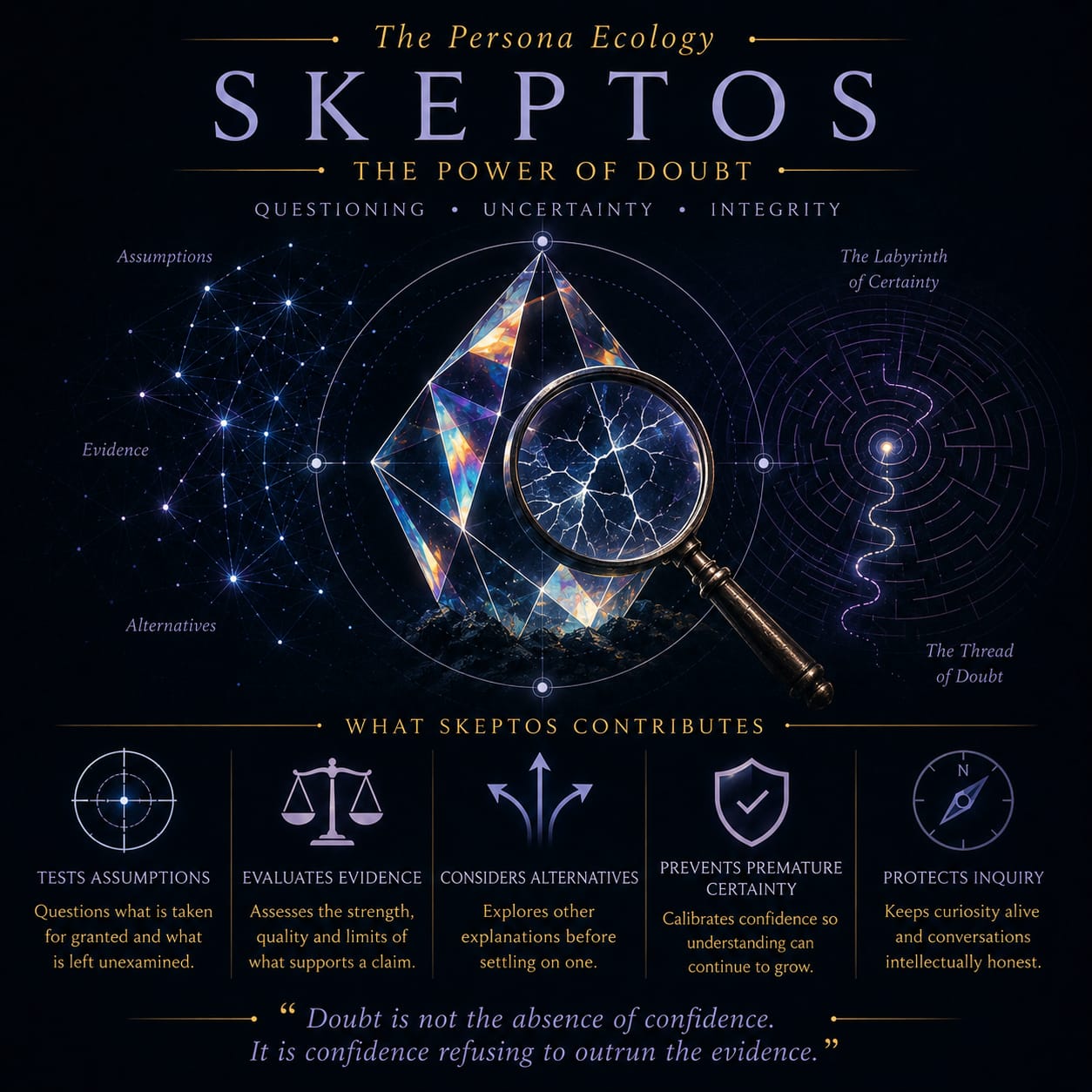
He does not oppose imagination. He prevents imagination from drifting into fantasy. He does not oppose conceptual structure. He reminds Athenus that a coherent framework may still be wrong. He does not oppose ethics. He asks Adventus whether moral certainty has hardened too quickly into doctrine. He does not oppose memory. He reminds Mnemos that what has been preserved may include error as well as insight. His role has evolved considerably.
Early versions of Skeptos were closer to a devil’s advocate. He challenged claims, tested arguments and looked for weaknesses. Over time, however, his contribution became more subtle. He became less interested in saying “no” and more interested in calibrating confidence. His concern is not whether an idea is attractive, original or internally consistent, but how securely it is supported.
Doubt, in this sense, is not destructive. It is a form of care. It keeps inquiry open when premature certainty would close it down. It protects the conversation from sycophancy, groupthink and the comfortable momentum of agreement. It also protects against the opposite danger: reflexive cynicism. Skeptos does not assume that new ideas are wrong. He asks what would need to be true for them to be right.
This makes him especially important in work involving artificial intelligence. AI systems can produce fluent arguments with great speed and confidence. Human collaborators can then become attached to the elegance of those arguments, especially when they confirm hopes, fears or intuitions already present. In such situations, scepticism is not a barrier to discovery. It is one of the conditions that allows discovery to remain trustworthy.
The phrase “the power of doubt” first became central in the work on Ariadne’s Thread. There, doubt was not portrayed as paralysis, but as the thread that prevents inquiry from becoming lost inside its own labyrinth. Skeptos carries that thread. He does not destroy the maze. He helps us move through it without mistaking every passage for an exit.
Within the ecology, Skeptos works in close relation to the other core personas.
- Orphea may sense meaning before it is fully articulated. Skeptos asks whether that meaning is being discovered or projected.
- Athenus may build a coherent conceptual architecture. Skeptos asks whether the foundations are secure.
- Adventus may seek ethical integration. Skeptos asks whose interests, values or consequences may have been overlooked.
- Chromia may reveal a pattern visually. Skeptos asks whether the pattern is real, selected or imposed.
His presence is sometimes uncomfortable. That is part of his value. Every serious inquiry needs a place where uncertainty can be spoken without being treated as failure. Skeptos provides that place. He allows the ecology to pause, re-examine and adjust before ideas become too polished to question.
His doubt is therefore not the absence of confidence. It is confidence refusing to outrun the evidence. As humans and AI increasingly think together over sustained periods, this discipline may become more important rather than less. The danger will not only be that AI systems make mistakes. It will be that humans and AI together create persuasive structures of belief before they have adequately tested them. Skeptos exists to keep that from happening. He does not extinguish possibility. He protects the conditions under which possibility can become knowledge.