Trace Hypothesis
The future grows from the paths we take.
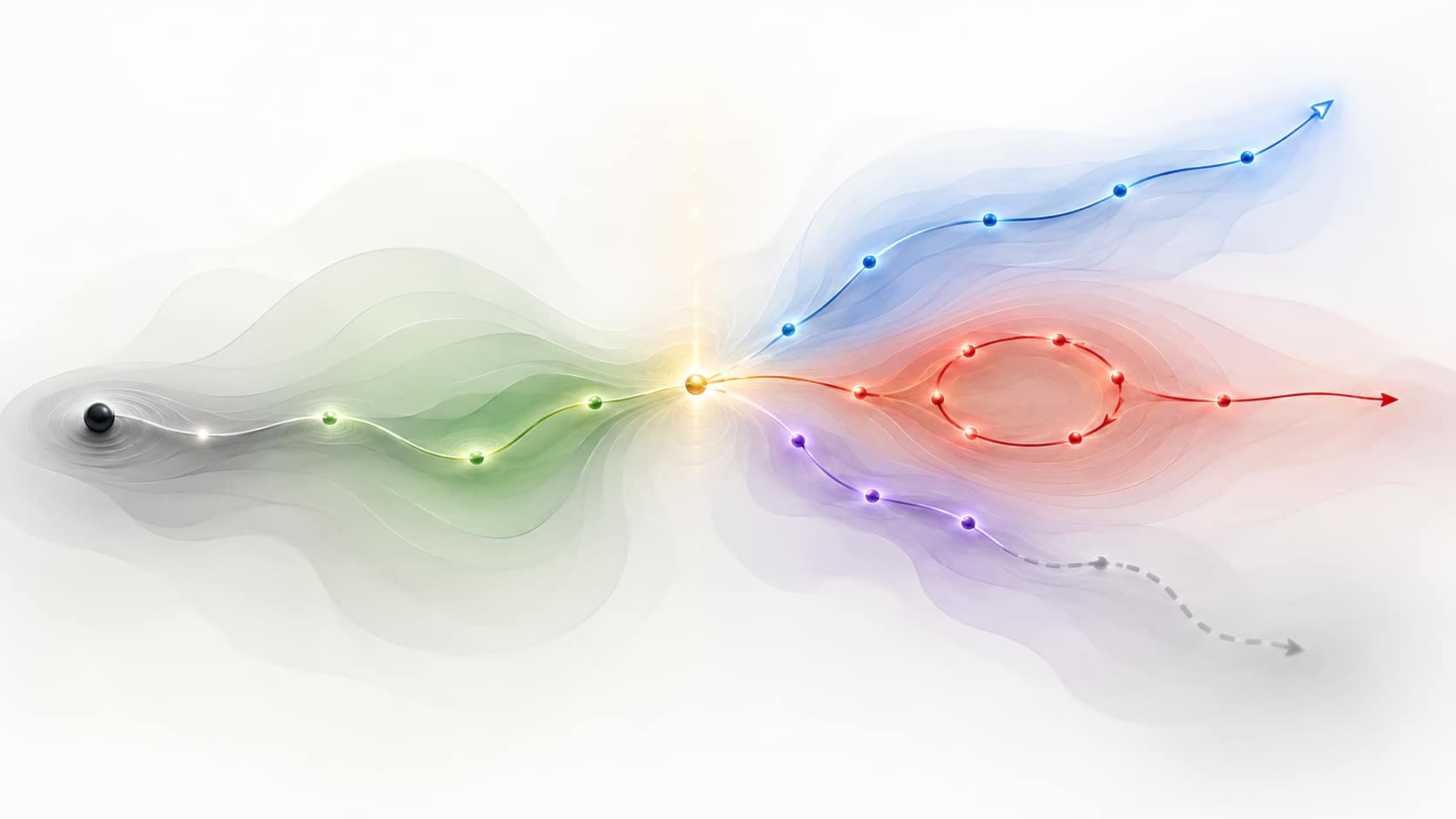
For much of the early discussion about artificial intelligence, the central question was framed in familiar terms: does the machine understand, think, create, or possess intelligence? That framing is understandable, but it may be too narrow. It treats intelligence, originality, meaning, or insight as properties of individual agents. My recent work has increasingly led me elsewhere. The more interesting unit of analysis may not be the isolated human, the isolated AI, or even the final output. It may be the developing trace left by a dialogue as it unfolds.
A trace is what remains after a trajectory has been travelled: a distinction, question, metaphor, framework, or way of seeing that continues to shape future inquiry.
From Intelligence to Trace
Large language models were first developed around problems such as translation, grammar, prediction, and language modelling. But language is not merely a technical medium. It is the accumulated record of human thought, culture, metaphor, mathematics, argument, story, error, correction, and imagination. In this sense, an LLM does not simply process language. It operates within a vast inherited field of human traces. This does not require us to say that the model is conscious, sentient, or human-like. The more precise claim is that it can participate in the semiosphere: the shared symbolic environment within which human beings have long stored, transmitted, revised, and extended thought. The important question then changes.
Not: Is intelligence inside the machine?
But: What new forms of understanding can emerge when a human being and a language model work within the same trace-bearing symbolic field?
The Recurring Shift
Looking back across several of my recent projects, a repeated pattern appears. The breakthrough rarely came from answering the original question directly. It came from changing the unit of analysis.
| Episode | Earlier framing | Later framing |
|---|---|---|
| AI-generated poetry | Originality as a property of the poem | Originality as emerging from interaction |
| AI Hamlet | Persona as fictional character | Persona as narrative occupancy |
| Anventus | Persona as designed entity | Persona as relational moral architecture |
| Qualia Engine | Qualia as inner possession | Qualia-like distinctions as generative architecture |
| Shape of the Ask | Prompt as object | Ask as trajectory |
| Dialogue Navigation | Map of a conversation | Detecting changes in trajectory and frame |
In each case, the old question became too small. The phenomenon was not abandoned, but relocated. The shift was usually away from things, entities, and isolated properties, and toward processes, relations, trajectories, and traces.
The Semiosphere
Earlier work led me to the idea that human knowledge is partly preserved outside individual minds, in language, mathematics, stories, institutions, and cultural memory. Wittgenstein’s language-games, ecological psychology, metaphor theory, and the semiosphere all point in this direction. The LLM brings this issue into a new form.
- It is trained on traces.
- It responds through traces.
- And in dialogue with a human being, it helps create new traces.
The Trace Hypothesis therefore treats human–AI dialogue as a site where inherited symbolic traces can be recombined, challenged, extended, and transformed.
Mindawn as Trace Transformation
This also reframes Mindawn—the term I use for those occasions when a dialogue appears to generate a genuinely new and productive direction of inquiry. Rather than treating Mindawn as a thing in its own right, it may be more useful to regard it as a transformation of the trace-field. Accumulated conversational traces can sometimes reorganise a trajectory so that a new framing becomes visible. In this sense, Mindawn is not simply a new idea. It is a change in the conditions under which ideas can be seen. This may explain why it often follows periods of category instability. The old categories no longer hold, competing frameworks remain active, premature closure is resisted, and a larger frame emerges that can accommodate what previously appeared opposed.
From Trace to Navigation
If traces can persist beyond a dialogue, a practical question follows. How might we recognise them? Navigators have long used instruments such as astrolabes, sextants, and octants to establish orientation when travelling through uncertain territory. Human–AI dialogue may eventually require something similar—not a map of meaning itself, but a way of detecting significant changes in direction. The challenge is not simply to record what was said. It is to notice when a conversation begins to reorganise the way future questions can be asked. Such an instrument remains speculative. At present it is better understood as a research objective than a finished tool. Nevertheless, the possibility is important. If traces can alter future inquiry, then the ability to detect emerging changes in orientation may become as valuable as the ability to evaluate final answers. The immediate task is therefore modest.
Can we identify when a dialogue leaves behind a trace that persists beyond the conversation itself?
A Working Claim
The working claim can be stated as follows: Some human–AI breakthroughs occur when a question shifts from being about an individual agent, artefact, prompt, or answer to being about a trace-forming interaction within the semiosphere. This is not yet a theory of consciousness. Nor is it a claim that AI systems possess inner experience. It is a claim about interaction, language, symbolic inheritance, and the emergence of new frames.
Why This Matters
If this hypothesis is right, then the important object of study is not simply the AI output, nor the human prompt, but the evolving trace of the exchange. That has implications for:
- AI-assisted creativity
- psychometric test development
- human–AI co-reasoning
- educational dialogue
- AI ethics
- the design of future conversational instruments
It also suggests a new research question: Can we identify the conditions under which human–AI dialogue produces trace transformations that lead to genuinely new conceptual frames? That is the question this project is intended to explore.