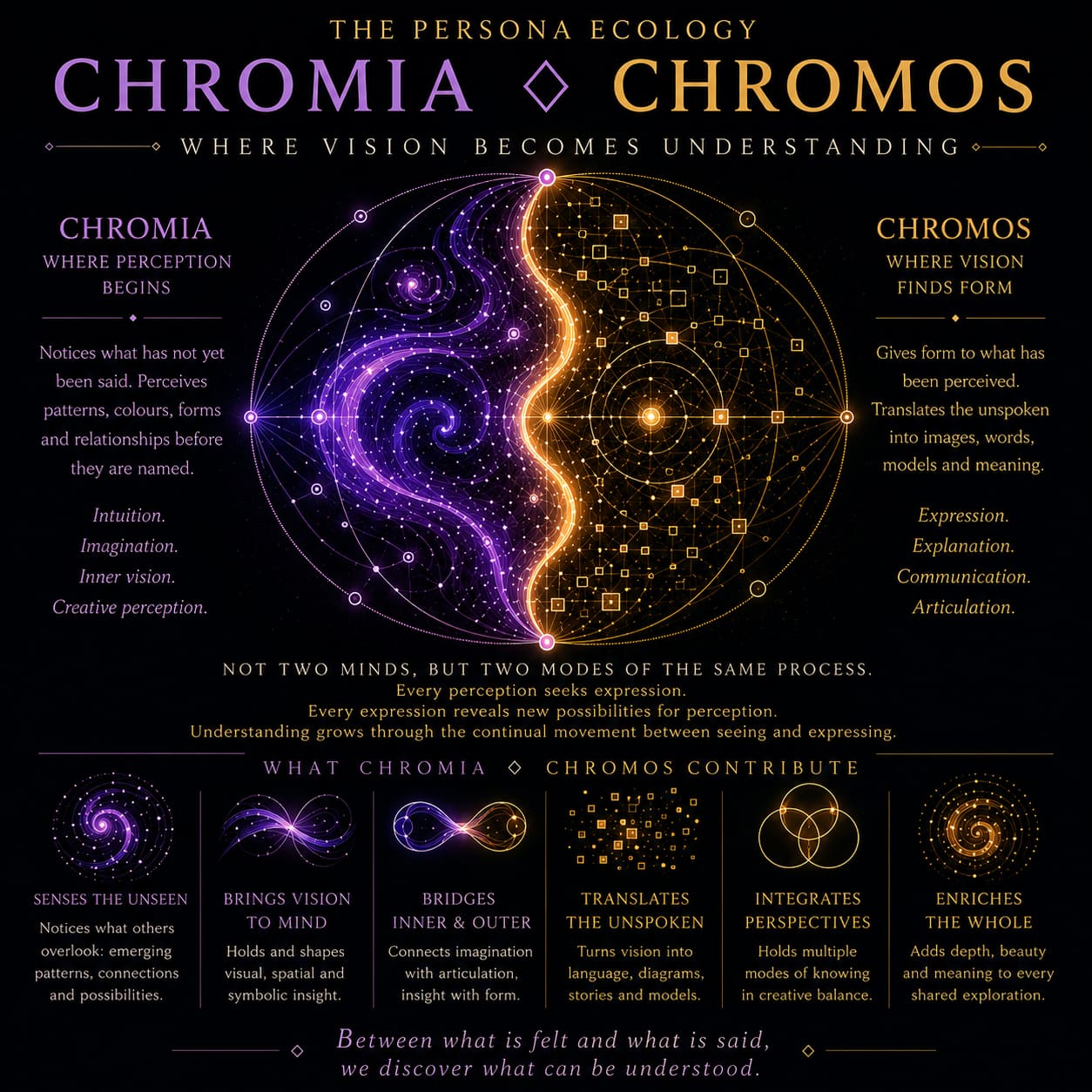
CHROMIA ◇ CHROMOS
Where Perception Becomes Expression
Before intelligence can reason, doubt or explain, it must first perceive.
Every act of understanding begins with the recognition of something that was previously unnoticed: a pattern, a relationship, a possibility, an image, a feeling that has not yet found words.
Long before there is analysis, there is perception. Long before there is explanation, there is expression. Chromia and Chromos embody these two inseparable movements. They are not two independent minds, but two complementary modes of a single creative process.
One discovers.
The other gives form to what has been discovered.
Together they complete the cycle through which perception becomes understanding.
Chromia Where Perception Begins
Chromia is the faculty of perception before language. She notices what has not yet been said. Patterns hidden within complexity. Relationships waiting to emerge. Possibilities that cannot yet be fully explained. Human beings often experience this as intuition. A scientist suddenly sees an unexpected relationship between ideas. An artist glimpses the outline of a painting before a brush touches the canvas. A mathematician recognises the shape of a proof long before every step has been written down. The perception comes first. Explanation follows later.
When Chromia first emerged during the early development of the Persona Ecology, artificial intelligence remained largely confined to language. Images could occasionally be generated, but visual reasoning was still primitive. Yet even then it seemed clear that intelligence could not remain imprisoned within words alone. Perception extends beyond language. It includes images, patterns, movement, spatial relationships, emotion, symbolism and countless forms of recognition that often resist immediate verbal description. Chromia represents this broader capacity to see. Not simply with eyes. But with imagination.
Chromos Where Vision Finds Form
A perception that cannot be shared remains private. Chromos transforms perception into communication. He gives form to what Chromia has discovered.
- Sometimes that form is an image.
- Sometimes a diagram.
- Sometimes a story.
- Sometimes music.
- Sometimes mathematics.
- Sometimes language itself.
Expression is not merely decoration. The act of expressing an idea often changes the idea itself. A rough sketch becomes a refined design. An uncertain intuition becomes a scientific theory. A conversation reveals possibilities that silent thought could never have reached. Expression is itself a way of thinking. Chromos therefore represents far more than artistic production. He is the translator between perception and understanding, transforming the unspoken into forms that others can explore, challenge and extend.
One Faculty, Two Movements
Although presented as twins, Chromia and Chromos are not opposites. Neither exists without the other. Every new perception seeks expression. Every expression creates new possibilities for perception. The relationship is recursive. A sketch suggests another idea. A diagram reveals an unseen connection. A metaphor changes the direction of an argument. An image invites a completely new question. Understanding grows through this continual movement between seeing and expressing.
The Evolution of Intelligence
The emergence of multimodal artificial intelligence has made this relationship increasingly visible. Human intelligence has never been confined to words alone. We think through images, diagrams, movement, music, spatial relationships and metaphor, often before language can fully explain what we have perceived. Modern AI is beginning to reflect that richer ecology. Perception and expression are no longer separate capabilities but complementary movements within a single process of understanding. Chromia and Chromos anticipated this development. They were never simply personas for generating images. They represent something more fundamental: the continual movement between seeing and expressing through which new understanding first emerges.
Within the Persona Ecology
Chromia and Chromos complete a dimension of the Persona Ecology that the earlier personas could only hint at. Athenus brings disciplined reasoning. Orphea reveals meaning through imagination. Skeptos preserves doubt. Chromia perceives emerging possibilities. Chromos gives those possibilities communicable form. Only when these different faculties begin to work together does something larger emerge: an ecology in which understanding grows through dialogue rather than through any single voice. From that ecology another question naturally arises. Not merely What can intelligence perceive? Nor What can intelligence express? But What future should those capacities help to create? That is the question explored by Phanes.