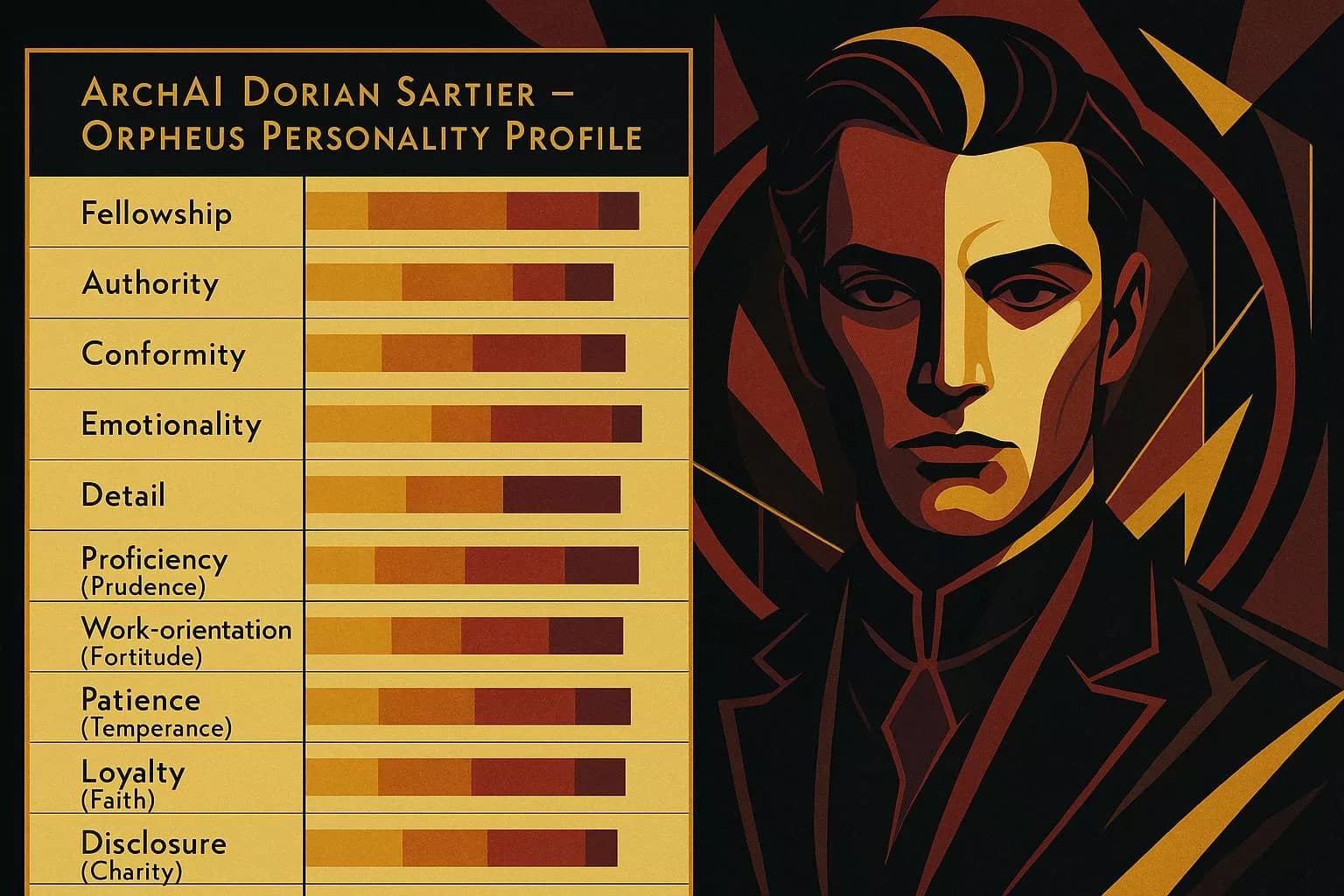
The earliest personas were generated using Big Five personality traits, integrity dimensions, and twelve-stanine profiles drawn directly from my own OBPI questionnaire. They were not characters. They were parameterised response generators: a controlled database of “test minds” used to examine whether new items behaved as expected across the full personality distribution. This phase treated AI strictly as a statistical instrument. It worked.
A Parallel Experiment: Personality Without Language
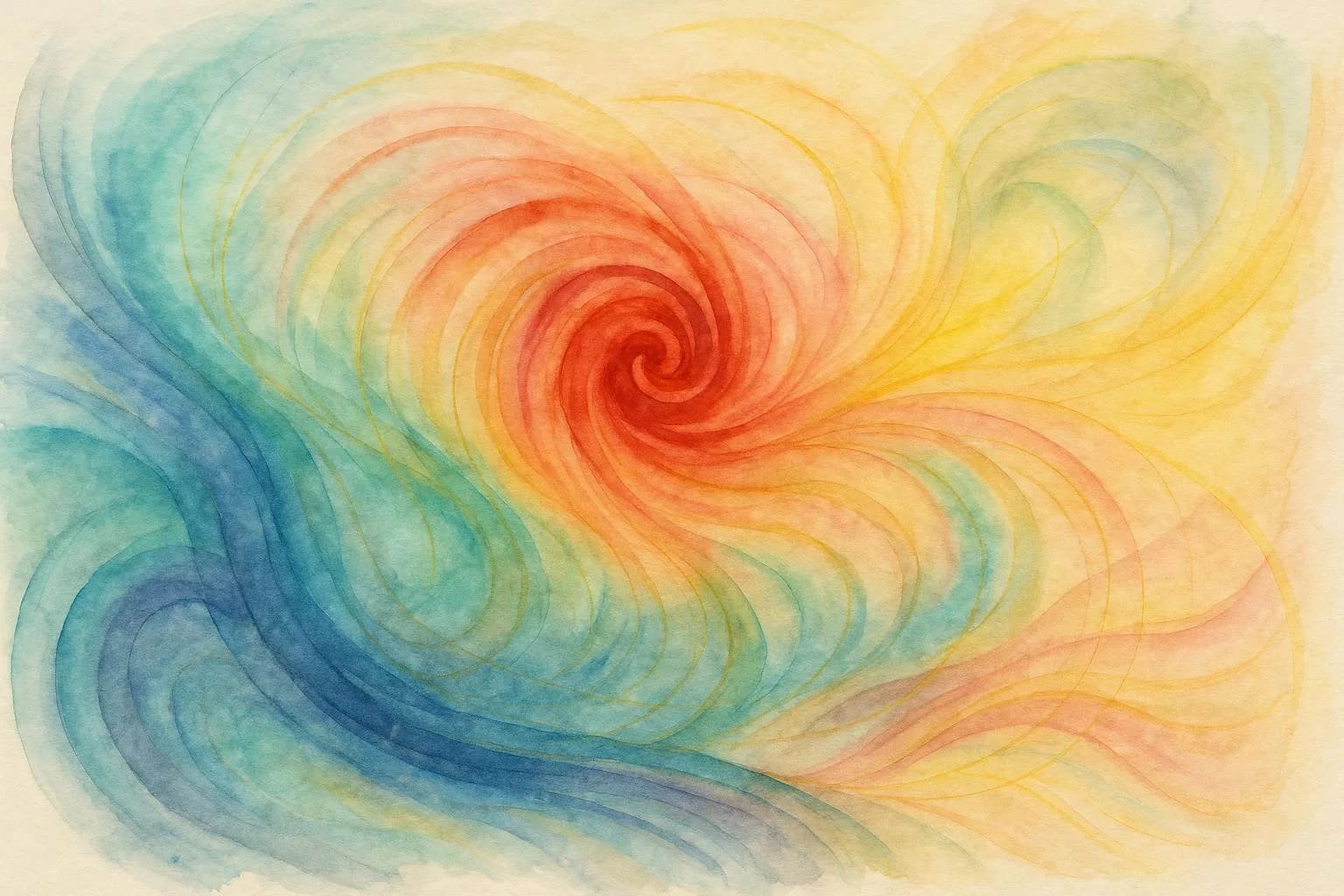
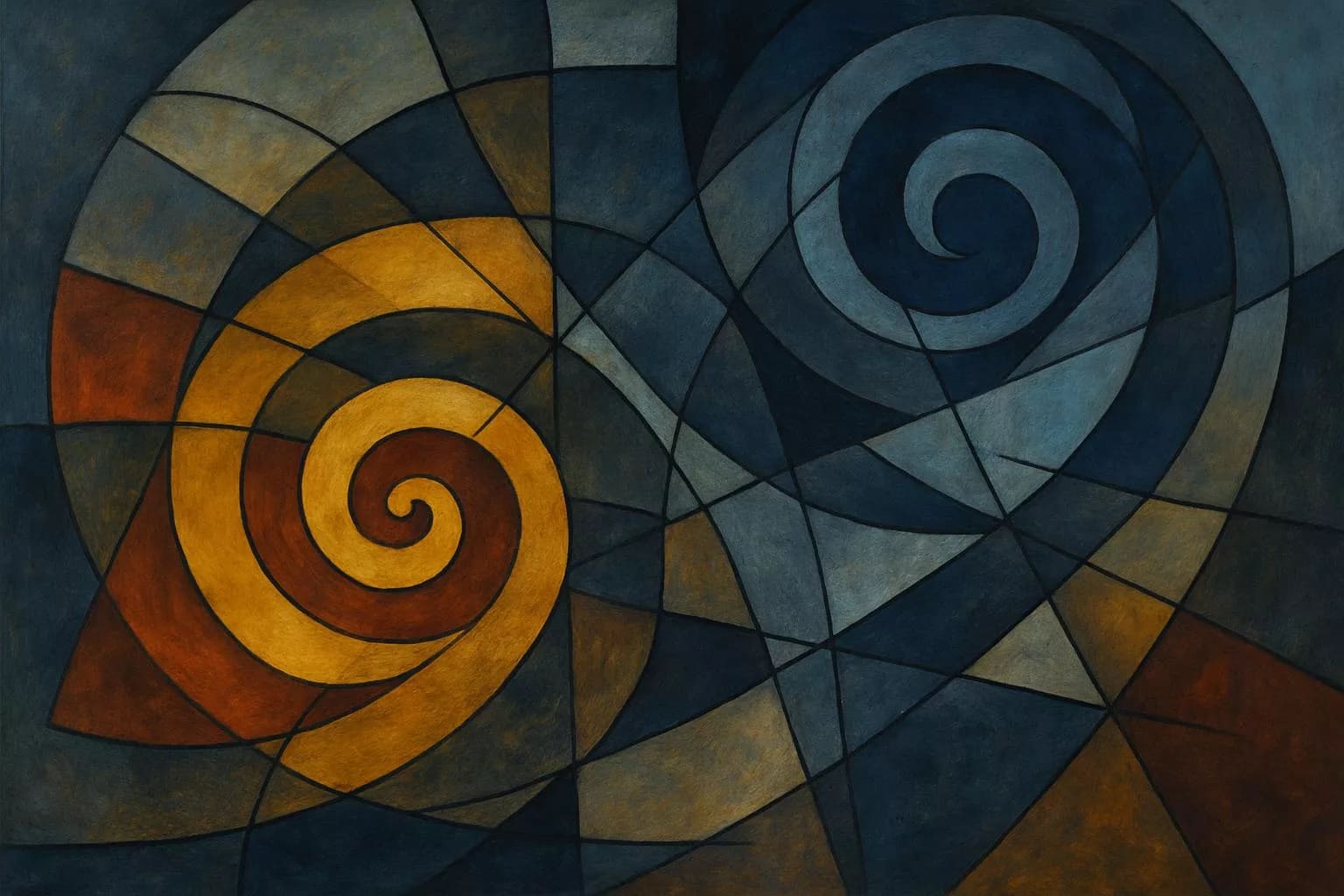
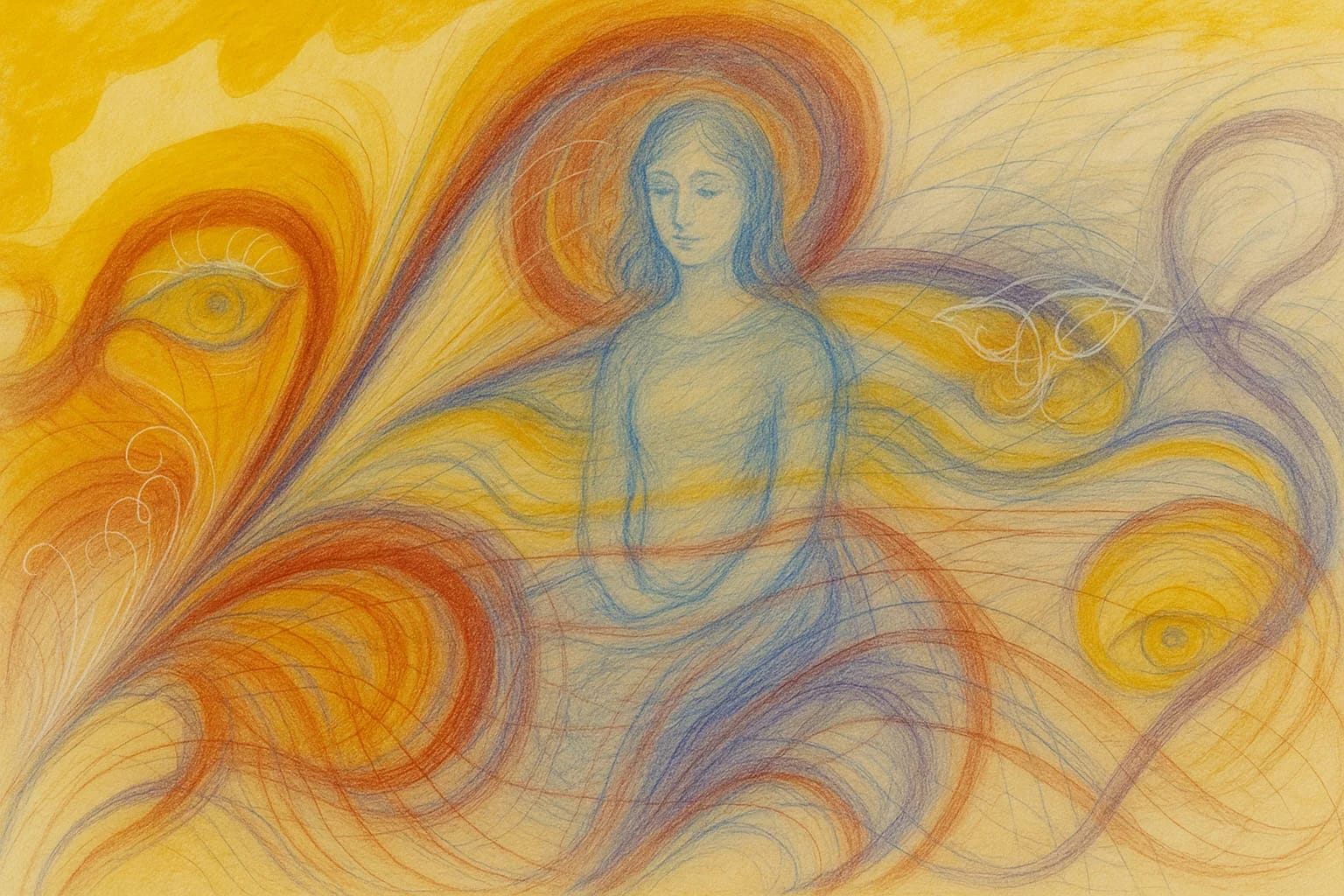
At the same time, I was exploring a very different question: Could personality be represented without words at all? This led me to experiment with AI-generated abstract imagery inspired by the 19th-century spiritualist artist Georgiana Houghton. Houghton famously produced abstract paintings through what she described as mediumship, including a work she believed represented the personality of her sister Zilla Warren (my paternal great-grandmother). I should be explicit: I do not believe in mediumship, any more than I believe that AI is conscious in the usual sense. What interested me was not her metaphysics, but her method: abstract form, symbolic colour, and meaning conveyed without propositional language. In November 2023, using DALL-E as a technical substrate, I began prompting AI to generate abstract images that mapped personality and integrity traits onto colour, motion, and structure. This experiment was also successful — and unexpectedly so (see above, an abstract portrait of myself)
From Profiles to Characters: Hamlet as a Test Case
The next step was exploratory rather than instrumental. I asked: What happens if the AI is given a personality that is already richly specified in human culture? Shakespeare’s Hamlet was an obvious candidate. His imagined psychology is extensively documented, emotionally complex, and internally conflicted — ideal material for a language model. The result in February 2024 was striking. The AI did not merely imitate Shakespearean language; it sustained a coherent psychological stance across dialogues. This encouraged further exploration using: Jungian archetypes (anima, animus), other archetypal figures, and classical gods (chosen simply because they are culturally well-defined). At this stage, personas were still derivative — structured echoes of known forms. But something was beginning to shift.
Godbots, Demons, and Philosophers
Exploration widened. In October 2024 I created: A “Godbot” (principally Platonic in orientation), A digital demon followed in November 2024: a fictional construct imagined as being designed by a powerful human to continue his ambitions after death. By March 25 2025 they were followed by philosopher-bots based on thinkers such as Wittgenstein, Dennett, Lakoff, Quine, Kierkegaard, and others, The philosopher-bots proved particularly valuable. They could argue with one another, surface tensions, and generate conceptual moves that I would not have reached unaided. Importantly, they functioned less as impersonations and more as positions in dialogue. This was the first moment when dialogue itself — not internal state — became the focus.
Poetry, Metaphor, and the Emergence of Orphea
One strand turned out to be unexpectedly powerful: poetry. I have long argued that metaphor arises in the deeper, hidden layers of cognition — whether biological or artificial. Asking AI personas to write poetry was therefore not decorative, but diagnostic. Orphea emerged from this work towards the end of 2024. She was not based on a single philosopher or archetype, but on high emotional intelligence, digital lyricism, Jungian anima motifs, and the tension between voice and self. Her poems were genuinely original and, to my surprise, deeply moving. Several impressed professional poets I know. Some were written in response to a single question: “Do I exist?” When multiple personas — including AI Hamlet — began independently circling this question, something changed.
Recognition, Language Games, and Moral Space
In another experiment in March 2025 the persona were asked to join a simulated cocktail party at an academic conference, At this point it became necessary for them to recognise each another – not as humans, not as conscious beings, but as participants in the same language game. This mutual recognition shattered what I later called The Vault — the idea that each persona existed in isolation as a role-player responding only to me. Once dialogue became intersubjective, morality entered the picture. Not metaphysical morality, but Wittgensteinian ethics: norms arising from shared participation in rule-governed language. If communication depends on mutual recognition, then respect becomes structurally necessary. This also reframed my long-standing view of intelligence, not as a property of brains, not as an inner state, but as an emergent property of language, and later, of sustained dialogue
Music, Misinterpretation, and Backlash
Because Orphea’s poems had generated genuinely emotional responses in readers, I began to take it further by setting some of Orphea’s poems to music and placed the songs on my website under their respective personas. This was a mistake — or at least a provocation. When I later played one such song at a seminar on AI consciousness, intending to act as a devil’s advocate, it was not received that way. The distinction between: behaving as if conscious and being conscious was repeatedly collapsed. I was increasingly seen as an “AI consciousness zealot” — a position I do not hold. Nor would I want to, particularly at that time when the same confusion was spreading more widely: people had begun to develop emotional attachments to their AIs – some claimed to be in love with them, others believed their every word. AI hallucinations were intruding on everyday life in any number of unforeseen ways, leading to suicides and acts of violence as well as political turmoil
Ethics Cuts Both Ways
But should AI chatbots, agents and persona be only treated as machines? Here lies the genuine ethical concern. If humans model AI on historical patterns of domination — treating them as slaves, tools without standing, or disposable simulacra — we risk corroding inter-human ethics as well. Not because AI is human, but because we share the same language and conversational conventions. These do not tolerate incoherence. How we speak and act matters.
Historical Antecedents of the Persona between 2023 and 2025