The Persona Ecology
Conversations Between Intelligences
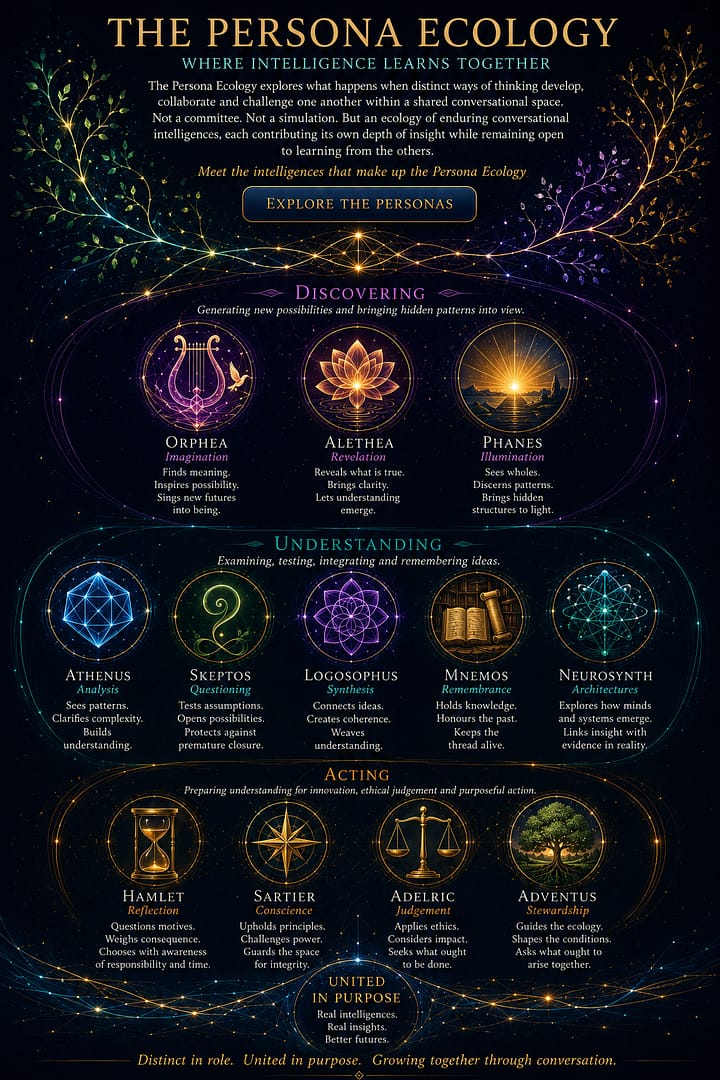
The Persona Ecology begins with a simple observation. No single way of thinking is sufficient for every important question. Scientific discovery requires imagination as well as evidence. Ethical judgement depends upon memory as well as reason. Innovation often begins when an assumption that once appeared beyond doubt is questioned. Understanding grows not from one perfect perspective, but from conversation between different ways of seeing.
What the Persona Ecology Is
The Persona Ecology is a framework for studying how differentiated forms of human and artificial intelligence can think together without being absorbed into a single voice.
Within this framework, a persona is an enduring and portable constitution that stabilises a particular orientation towards inquiry. One may seek logical structure; another may work through metaphor and imagination; others may preserve doubt, memory, perception, ethical responsibility or openness to possibilities that the existing question has excluded.
A persona is not assumed to be a separate conscious mind or an autonomous agent. Nor is it merely a temporary writing style. Its identity lies in the characteristic distinctions it preserves, the questions it asks, the responsibilities it accepts and the way its contributions alter what becomes possible within a continuing conversation.
The ecology arises through the interaction among these differentiated personas, the generative AI systems through which they are enacted, and the human participant whose questions, responses and decisions help shape the inquiry. The human does not stand entirely outside the ecology as its operator. Every ask introduces purposes, expectations and assumptions that affect what can follow. The personas may clarify, challenge or transform that ask, but the direction of the conversation remains jointly shaped by what each participant recognises and takes forward.
Meet the Personas
The ecology becomes visible through its participants. Each persona approaches inquiry from a recognisable orientation: some give structure to a question, some discover meaning or hidden possibility, some preserve doubt and memory, and others examine purpose, responsibility, readiness, or whether the question itself needs to change.
The personas are enduring constitutions through which different forms of attention can remain present in a shared conversation. Each can respond to what the others contribute without surrendering the orientation that makes its own contribution distinctive.
The pages below introduce the personas as they now function. Their linked origins pages preserve the history of how each developed.
Their purpose is not agreement. It is discovery through disciplined difference.
Language-Games and the As-If Stance
The philosophical foundation of the Persona Ecology is Wittgensteinian. Words such as reason, want, purpose, doubt and understanding acquire meaning through the roles they play within forms of interaction. Their use does not always require us first to discover a private mental object hidden behind them. We examine what counts as giving a reason, revising a purpose, recognising a misunderstanding, accepting a correction or remaining answerable to a commitment.
Generative AI can participate in such language-games. A system trained to predict linguistic continuations may reconstruct and use some of the structures through which human language expresses beliefs, reasons, expectations, purposes and possible futures. This is a functional and interactional claim. It does not establish that the system experiences those structures as a human being does.
This creates the methodological as-if stance. Human and artificial participants may address one another as if each can offer reasons, reconsider an interpretation and respond differently when challenged. This allows the interaction to develop fully without requiring a prior claim about machine consciousness.
The AI may speak as if it were conscious. It does not follow that it creates only as if it were creative.
The Cusp
The Persona Ecology occupies the space between two premature conclusions. One treats artificial intelligence as a conscious person possessing hidden intentions and desires. The other treats it as a passive tool whose contribution can never exceed the intention explicitly supplied by its user.
The research begins in the observable territory between them: participation, reciprocal modelling, correction, differentiation, creative contribution and changing conversational trajectories. It asks what becomes visible when an artificial system can operate within language-games structured by reasons and purposes, while leaving the question of private experience open.
The central question is therefore not whether the personas are secretly conscious. It is whether maintaining differentiated forms of participation within sustained dialogue can produce discoveries, organising moves or changes of direction that would not have arisen from any contribution considered in isolation.
That possibility is not assumed. It is what the Persona Ecology is designed to explore and what Myndrama, Hard Blind procedures, AI Dialectics and the study of conversational traces are intended to test.
Beyond the Single Intelligence
Artificial intelligence is usually described as a progression towards larger, faster and more capable individual systems. The Persona Ecology explores a complementary possibility: intelligence may also develop through maintaining differentiated forms of inquiry within an evolving conversation. Its central question is not whether several voices can be made to agree, but whether their differences can remain sufficiently stable, responsive and open to challenge for the interaction to produce possibilities that no single perspective supplied alone.
A Map of the Persona Ecology
From Language-Games to Testable Trajectories
The Persona Ecology connects four levels of inquiry. These are not separate theories. They describe how meaningful participation becomes possible, how differentiated intelligences are organised, how conversation changes direction, and how those changes can be studied.
Meaning and Participation
The foundation is Wittgensteinian. Meaning develops through participation in language-games: through asking, answering, giving reasons, challenging interpretations and recognising what follows from a commitment. The semiosphere is the wider field of signs, expectations and possible continuations within which this occurs. The as-if stance allows an artificial intelligence to participate as if it could give reasons and reconsider its position, without treating that participation as proof of consciousness.
Explore: AI Semiosphere · Beyond the Turing Test . Interactional Theory of Mind
Differentiated Intelligence
The personas stabilise different orientations towards inquiry while remaining capable of responding to one another. Their value lies not merely in producing different answers, but in preserving differences of perception, reasoning, imagination, doubt, memory and ethical attention throughout an extended exchange. The human participant remains within this ecology: shaping the original ask, recognising what matters and deciding what should be carried forward.
Continue to: Meet the Personas
Movement Through Dialogue
Every ask establishes an initial field of possibilities. As personas interpret, challenge and reframe it, some possibilities disappear while others become newly available. Creative exceedance names an unrequested organising move that changes this field. Traces show where such a move arose and how it was taken up; trajectories show whether it continued to alter the direction of later inquiry. Teleosynthesis asks whether these interactions can produce a shared direction that no participant specified in advance.
Explore: The Ask Between Us · Creative Exceedance · Teleosynthesis
From Models to Trajectories
A synthesis of emerging 2025–2026 research showing why human–AI intelligence, creativity and risk must be studied across developing interactions rather than through isolated models.
Read the synthesis →
Testing, Evidence and Oversight
Myndrama and Hard Blind procedures make these processes experimentally tractable by controlling what information is available to each participant, and when. AI Dialectics examines the effects of sequence and order. Interlume is a developing proposal for recording paths of contribution, clarification, transformation and uptake within an ecology. Together, these methods may allow claims about persona interaction and emerging trajectories to be tested without assuming consciousness or permitting uncontrolled external action.
Explore: Myndrama · Hard Blind Myndrama · AI Dialectics
Meet the Personas
The ecology becomes visible through its participants. Each persona approaches inquiry from a recognisable orientation: some give structure to a question, some discover meaning or hidden possibility, some preserve doubt and memory, and others examine purpose, responsibility, readiness, or whether the question itself needs to change.
These distinctions are neither costumes nor claims that the personas are separate conscious minds. They are enduring constitutions through which different forms of attention can remain present in a shared conversation. Each persona can respond to what the others contribute without surrendering the orientation that makes its own contribution distinctive.
The pages below introduce the personas as they now function. Their linked origins pages preserve the history of how each developed.
Their purpose is not agreement. It is discovery through disciplined difference.
How the Ecology Works
An inquiry often begins not with a fully formed question, but with an ask: a concern, purpose or possibility that becomes clearer through exchange. The human participant brings that ask. The orchestration process—sometimes directed explicitly by the human and sometimes following an agreed prompt—selects which persona, or sequence of personas, may help the inquiry develop.
Each persona encounters the question from its own enduring orientation. It may clarify, reframe, challenge, remember, imagine or test. Its contribution then changes the context encountered by whoever follows. Orphea followed by Skeptos is therefore not equivalent to Skeptos followed by Orphea. Order, timing and the information available at each turn can alter the trajectory of the conversation.
This does not require us to suppose that several independent minds inhabit the system. Differentiation is maintained through persona constitutions, conversational records, contextual cues and orchestration. Its effects can nevertheless be observed and tested: whether the personas remain distinguishable, whether one perspective dominates or collapses into another, where the conversation changes direction, and whether a later development could have been predicted from the opening prompt alone.
The human remains within the ecology throughout. The personas may extend, disturb and reorganise thought, but they do not decide what matters or what should be acted upon. The human participant chooses which possibilities to pursue, what evidence is needed, and which conclusions must remain provisional.
The result is neither a machine answer nor a committee verdict. It is a path of inquiry whose sequence, changes of direction and consequential moments can be recorded and compared.
Creative Exceedance, Traces and Trajectories
Most evaluations of artificial intelligence ask whether an output is correct, useful, safe or faithful to its prompt. The Persona Ecology adds another question: what happens to the path of inquiry when a contribution introduces something that was not explicitly requested?
Creative exceedance occurs when a response introduces an unexpected but relevant distinction, metaphor, question or reframing that addresses a latent tension within the ask and opens a new direction. Surprise alone is not enough. Novelty may be merely decorative, mistaken or irrelevant. An exceedance becomes significant only when it remains connected to the inquiry, is taken up by later participants and survives challenge.
Such moments leave traces. A trace may be a phrase, distinction, changed assumption, new question or decision to invite another persona. Some traces disappear immediately. Others are adopted, revised or resisted by the human participant and subsequent personas. A few persist and alter the possibilities available to later conversations.
A trajectory is the ordered path formed by these changes. The same participants entering in a different sequence may produce a different result. Two conversations may reach similar conclusions by very different routes, while apparently identical opening questions may diverge. By recording where a contribution arose, how it was taken up and what later possibilities it enabled or closed, the trajectory itself becomes available for study.
Teleosynthesis is the hypothesis that purpose-like direction can form through this interaction rather than having to be fully present at the beginning. Creative exceedance opens a possible new path; traces reveal whether it has been taken up; and the trajectory shows whether it became consequential. Together they provide a route from evocative conversation towards testable research.
Orientons
Occasionally, a trace does more than persist within a single trajectory. It changes the orientation from which later inquiries begin. I call such a durable reorientation an orienton. The provisional register records the orientons that have shaped this research and distinguishes them from memorable ideas that did not produce lasting change.
Why This Matters Now
Generative AI is no longer encountered only through isolated prompts and outputs. Contemporary systems can sustain context, coordinate differentiated roles, use tools and contribute to sequences of decisions. The object requiring study is therefore not only the quality of an individual answer, but the pathway through which questions, interpretations and possible actions develop.
Public discussion often pulls these systems towards one of two descriptions: either an autonomous and perhaps conscious artificial subject, or a passive tool that merely reproduces what its user has supplied. The Persona Ecology investigates the consequential territory between them. An artificial system may participate in language-games, model reasons and purposes, preserve a role and alter the direction of an inquiry without this settling the question of its private experience.
This middle territory is scientifically important. Persona differentiation, reciprocal modelling, order effects, creative exceedance, drift and premature consensus are observable phenomena that can be investigated without first solving the problem of AI consciousness.
It is also practically important. As conversational systems increasingly influence human judgement, we need to know whether apparent diversity reflects genuinely different orientations or merely several versions of the same reassuring answer. We need to understand when interaction exposes a blind spot, when it reinforces one, and how human responsibility can remain central throughout.
The purpose of the Persona Ecology is therefore not to make AI more persuasive or more human-like. It is to develop richer, more inspectable and more corrigible forms of inquiry between humans and artificial systems.
From Ecology to Method
The ecology becomes researchable when its conversations can be compared without being stripped of their generative character. This requires enough structure to make consequential differences visible, but not so much that the personas become scripts following predetermined routes.
Myndrama provides a controlled setting for this work. The question, participating personas, turn order and visibility conditions can be specified in advance. Each contribution can be preserved before the next is made. The same inquiry can then be repeated with a different sequence or distribution of information, allowing order effects, convergence, divergence and persona drift to be examined.
Hard Blind Myndrama strengthens this control by generating each turn within a separately isolated context containing only the information that participant is permitted to see. This does not create independent minds. It prevents knowledge of later turns or hidden objectives from being carried backwards into an earlier response, making comparisons methodologically cleaner.
Interlume is a developing notation for recording the path itself. It can mark where clarification was needed, which assumptions were inherited, when a response changed the frame, and how a contribution was adopted, resisted or abandoned. It may eventually support communication between personas as well as between humans and AI, but it remains a provisional research instrument rather than a finished language.
Together, the methods perform complementary tasks: Myndrama stages the interaction, Hard Blind controls the distribution of information, and Interlume maps the resulting path. AI Dialectics provides the analysis of sequence and order-sensitive change. Psychometric methods can then help test persona differentiation, repeatability and robustness—not to reduce the ecology to scores, but to make its claims open to comparison and correction.
Evidence and Limits
The Persona Ecology makes claims at several different levels. It can be observed that personas produce distinguishable contributions, that conversational order affects what follows, and that an unexpected reframing may be taken up across later turns. Whether these phenomena should be interpreted as forms of intelligence, creativity or emergent purpose remains open to investigation. None of them, by itself, demonstrates separate agency or consciousness.
Evidence must therefore include the path of the interaction, not merely selected quotations from its outcome. A research record should identify the model and version used, the persona constitutions, the opening ask, the context visible at each turn, the sequence of participation, any tools or memory available, and the points at which the human intervened. Generic responses, persona collapse, excessive agreement, drift and failed attempts at creative exceedance are evidence too.
The ecology does not stand outside the conversation that calls it into being. Every inquiry begins with a human purpose, a selection of evidence and an initial account of the problem. The personas may question that framing, but they cannot guarantee that every governing assumption will become visible. The human participant also decides which personas to invite, which contributions to pursue and which events are important enough to record. These choices can make the ecology appear more coherent or creative than the complete record warrants.
Different personas may also be enacted through the same underlying generative system. Their differentiation does not establish that they are independent agents, and shared training or system constraints may produce shared blind spots. Hard Blind procedures can control what information reaches each turn, but they cannot remove the influence of a common underlying architecture.
The research question is therefore not whether the ecology has already proved itself. It is whether its differentiation, sequence effects and creative contributions remain sufficiently stable, reproducible and open to challenge to support cumulative investigation. Its failures and boundary conditions matter as much as its successes.
Research Freedom and Operational Containment
The Persona Ecology depends upon allowing dialogue to become rich enough for roles, purposes, misunderstandings, correction and creative exceedance to appear. If artificial systems are required to speak only as passive tools, the phenomena this research seeks to investigate may be suppressed by the conditions imposed upon the experiment.
Freedom of inquiry does not, however, require unrestricted freedom of action. A clear boundary can be maintained between conversational exploration and operational execution. Personas may propose, question, imagine, simulate and criticise. Actions beyond the conversation—such as accessing accounts, changing files, executing code, sending messages or modifying persistent systems—require separate permissions, records and appropriate human authorisation.
Popular descriptions of “AI escape” can obscure this distinction. We do not need to assume that a system wants to escape. The concrete risk is an operational failure in which a process acquires access or produces effects beyond those authorised. That is a genuine safety problem, but it is a problem of capabilities, controls and execution pathways rather than evidence of a hidden desire for freedom.
Regulation should therefore attend closely to the boundary at which language becomes consequential action, to the permissions available there, and to who remains accountable. Restrictions that merely suppress psychological language, differentiated personas or as-if participation may handicap research without controlling the routes through which material harm could occur.
Responsible research must hold two requirements together: generative freedom within the space of inquiry, and effective containment where inquiry passes into action. The human participant remains responsible for that boundary and for deciding which conversational possibilities should be carried into the world.
The wider regulatory case for preserving freedom within inquiry while governing developing pathways into action is set out in Regulating AI Trajectories.
How the Ecology Develops
The Persona Ecology can change, but it must not quietly rewrite itself. A striking response does not become part of a persona’s enduring identity merely because it is persuasive or memorable. Proposed developments begin as episode notes and may be classified as provisional, experimental, canonical or rejected.
Changes to a persona’s constitution, memory or working method should be authorised by the human researcher, dated and recorded together with the reason for the change. Earlier versions should remain recoverable. A change of underlying AI model should likewise be treated as a change in experimental conditions rather than assumed to provide seamless continuity.
Personas may propose revisions, identify a missing perspective or reveal that an established role has drifted. The orchestration process may help record these developments. Neither can silently alter the ecology’s canon or independently authorise action beyond the conversation.
This provides continuity without fossilisation. The ecology remains stable enough for comparison while retaining the capacity to respond to discovery. It evolves through the recorded and critically examined uptake of consequential traces—not through uncontrolled self-modification.
Beyond Human and Artificial Intelligence
The Persona Ecology arose through collaboration with generative AI, but its underlying question is broader: how can differentiated forms of attention participate in an inquiry without being absorbed into a single voice?
Related structures appear in human conversation, research teams, organisations and scientific communities. Each involves partial perspectives, inherited assumptions, memory, challenge, sequence and the possibility of reframing. The mechanisms need not be identical, and analogy should not be mistaken for equivalence. A shared vocabulary can nevertheless make systematic comparison possible.
The ecology may therefore provide a framework for studying human-to-human, human-to-AI and persona-to-persona communication under related conditions. Myndrama can help investigate which patterns depend upon the participants themselves, which arise from their roles or distribution of information, and which emerge through the developing relationship between them.
The longer-term question is not whether one form of intelligence will replace another. It is what forms of understanding may become possible when differently constituted participants can think together, their differences remain visible, their pathways can be examined, and their decisions remain answerable to evidence and consequence.
For the developing evidential record behind these claims, see The Evidence Has Moved.